

Rufous-tailed Hummingbird vs Blue-chested Hummingbird
Amazilia tzacatl versus Polyerata amabilis
Play a quiz with Rufous-tailed Hummingbird and Blue-chested Hummingbird
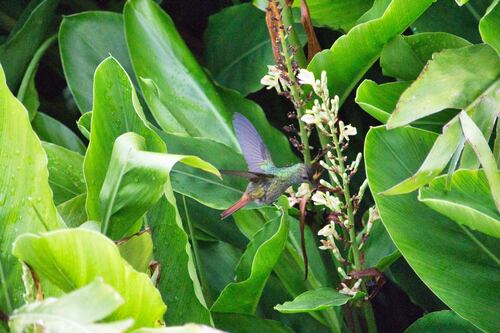 Rufous-tailed Hummingbird
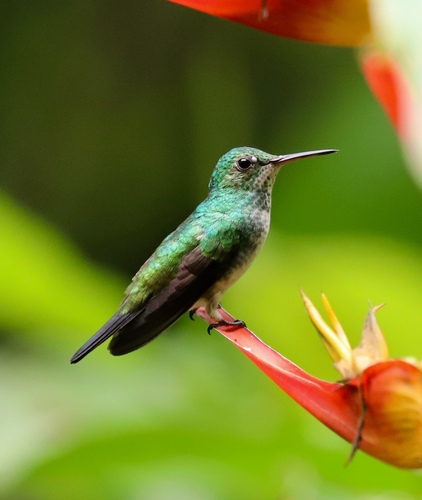 Blue-chested Hummingbird
In short
The most reliable field mark to separate Rufous-tailed Hummingbird from Blue-chested Hummingbird is the tail: Rufous-tailed always shows a mostly rufous (chestnut-brown) tail with only limited green at the tips and outer webs, while Blue-chested Hummingbird has a tail that is much darker and lacks extensive rufous. In all plumages, Rufous-tailed also shows more rufous on the uppertail coverts and undertail coverts, and its underparts are paler with a grayish or whitish belly, while Blue-chested has a more uniform greenish or bluish underside. Juvenile Rufous-tailed Hummingbirds can show a cinnamon wash on the lower breast and rump, which Blue-chested never has. Bill color and structure also differ subtly. These marks are visible both when perched and in flight, but the tail color is the most consistent separator at all ages.
Identification tips
- Tail color is the single best field mark: Rufous-tailed Hummingbird always shows a mostly rufous (chestnut-brown) tail, visible both when perched and in flight. Blue-chested Hummingbird's tail is much darker, lacking extensive rufous.
- Uppertail and undertail coverts: Rufous-tailed has chestnut-brown uppertail and undertail coverts; Blue-chested does not. Check for these rufous patches when the bird fans its tail or shifts position.
- Juvenile/immature underparts: Juvenile Rufous-tailed Hummingbirds show a cinnamon wash on the lower breast and sides, and cinnamon-tipped lower back/rump feathers. Blue-chested juveniles are more uniform below and lack any cinnamon tones.
- Belly color: Rufous-tailed adults have a gray lower breast and white belly, contrasting with the green upper breast. Blue-chested is more uniform below, with greenish or bluish tones extending through the underparts.
- Throat pattern: Rufous-tailed males have green throats with thin white scalloping; females show more pronounced scalloping. Blue-chested throats are more uniform and lack this scalloping.
- Bill color: Rufous-tailed has a bicolored bill (red base, black tip), especially obvious at close range. Blue-chested's bill is usually darker overall, sometimes appearing all dark.
- Habitat context: In open areas, gardens, and at feeders, Rufous-tailed is more likely. In humid forest interiors or heavily degraded former forest, Blue-chested is more likely, though overlap occurs at edges.
- Behavior at feeders: Rufous-tailed is notably aggressive and dominant at feeders, often chasing other hummingbirds. Blue-chested is less aggressive.
- Perched posture: Rufous-tailed often perches conspicuously in open, with tail slightly fanned or cocked, showing off the rufous color. Blue-chested is more likely to perch in denser cover.
- Vocalizations: If you hear a hard, smacking 'tchik-tchik' or a rattling 'chirr-rr-rr-rr-rr,' Rufous-tailed is likely. Blue-chested's vocalizations are less well known and not distinctive in the field.
- Sex differences: Female Rufous-taileds are paler below with more pronounced throat scalloping; Blue-chested females are more uniform.
- Subspecies variation: Rufous-tailed shows some geographic variation in bill color and tail pattern, but always retains the rufous tail as a key mark. Blue-chested does not approach this coloration in any subspecies.
- Flight views: Even in quick flight views, the rufous tail of Rufous-tailed Hummingbird flashes distinctly, while Blue-chested's tail remains dark.
- Pitfalls: Do not rely on overall green coloration or size, as both species are similar in these respects. Focus on tail and underpart color.
- When marks fail: In poor light, the rufous tail of Rufous-tailed may appear darker, but it will never be as uniformly dark as Blue-chested. Look for any hint of rufous in the tail or undertail region to confirm Rufous-tailed.
Size
Rufous-tailed Hummingbird is a medium-sized hummingbird, 9–11 cm in length and about 5 g in weight [wikipedia]. Blue-chested Hummingbird is similar in size, but the available notes do not specify precise measurements for direct comparison. In the field, size alone is not a reliable separator between these two species, as both are within the same general size class and overlap extensively.
Plumage
- Juveniles/immatures: Rufous-tailed Hummingbird juveniles have a distinctive cinnamon wash to the lower breast and sides, and the lower back and rump feathers are tipped cinnamon. This is absent in Blue-chested Hummingbird juveniles, which are more uniform below and lack any cinnamon tones.
- Tail: At all ages, Rufous-tailed Hummingbird shows a mostly chestnut-brown (rufous) tail with only limited bronze-green on the outer webs and tips. Blue-chested Hummingbird has a much darker tail, lacking the extensive rufous; its tail is more uniformly dark or greenish-black.
- Underparts: Adult Rufous-tailed Hummingbird males have a green throat and upper breast, gray lower breast, white belly, and chestnut undertail coverts. Females are paler below with more pronounced scalloping on the throat. Blue-chested Hummingbird is more uniform below, with greenish or bluish tones extending through the underparts and lacking the pale gray/white belly and rufous undertail.
- Uppertail/undertail coverts: Rufous-tailed shows chestnut-brown uppertail and undertail coverts; Blue-chested does not.
- Bill: Rufous-tailed has a bicolored bill (red base, black tip); Blue-chested's bill is usually darker overall.
Behaviour
Rufous-tailed Hummingbird is known for being aggressive at feeders and sometimes nests in loose colonies. It frequents open areas, gardens, and forest edges, often perching conspicuously. Blue-chested Hummingbird is less aggressive and more associated with denser, moister forests and degraded woodland. Both species hover and feed in typical hummingbird fashion, but Rufous-tailed is more likely to be seen in open, disturbed, or human-modified habitats.
Habitat
Rufous-tailed Hummingbird prefers open, non-forested habitats such as clearings, gardens, forest edges, and young secondary growth. It is common at feeders and in disturbed areas. Blue-chested Hummingbird is more tied to subtropical or tropical moist lowland forest and heavily degraded former forest. While ranges overlap in Central America and northern South America, Rufous-tailed is more likely in open or edge habitats, while Blue-chested is more likely in humid forest interiors or edges.
Voice
Rufous-tailed Hummingbird gives a varied, high, thin, squeaky song and hard, smacking 'tchik-tchik' calls, sometimes repeated insistently, as well as dry, hard chips and rattling 'chirr-rr-rr-rr-rr' notes. There are no detailed vocalization notes for Blue-chested Hummingbird in the provided sources, so voice is not a reliable separator unless Rufous-tailed's distinctive calls are heard.
Rufous-tailed Hummingbird · Blue-chested Hummingbird · My Tricky Birds