

Rusty-margined Flycatcher vs Purple Honeycreeper
Myiozetetes cayanensis versus Cyanerpes caeruleus
Play a quiz with Rusty-margined Flycatcher and Purple Honeycreeper
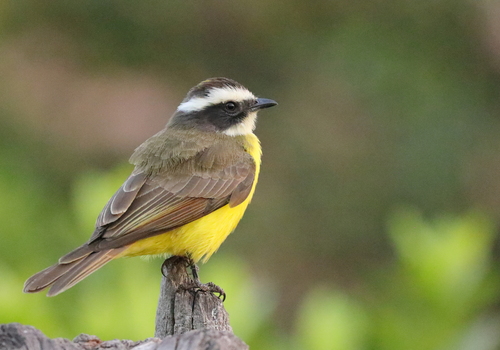 Rusty-margined Flycatcher
 Purple Honeycreeper
In short
The most reliable field mark for separating Rusty-margined Flycatcher from Purple Honeycreeper is the combination of size, structure, and bill shape: the flycatcher is much larger, with a thick, straight bill, while the honeycreeper is tiny and has a slender, strongly decurved bill. Juvenile Rusty-margined Flycatchers show rusty-cinnamon edges on the wings and tail, which never appear on honeycreepers of any age. Adult male Purple Honeycreepers are unmistakably violet-blue with black wings and mask, while female and juvenile honeycreepers are greenish with buff and blue face markings, never resembling the brown-and-yellow flycatcher. In flight or perched, the flycatcher’s robust, upright jizz and the honeycreeper’s small, active, and slender appearance are also strong clues.
Identification tips
- Size and bulk: Rusty-margined Flycatcher is much larger and heavier than Purple Honeycreeper. If the bird looks sparrow-sized or smaller, it is not a flycatcher.
- Bill shape: The flycatcher has a thick, straight, stubby black bill; the honeycreeper has a slender, strongly decurved black bill. Bill shape is visible even at a distance and is diagnostic.
- Juvenile wing and tail edges: Juvenile Rusty-margined Flycatchers show prominent rusty-cinnamon edges on wings and tail, never present on honeycreeper of any age. If you see rusty or rufous on the wings/tail of a brownish bird, think flycatcher.
- Adult male plumage: Adult male Purple Honeycreeper is vivid violet-blue with black mask and wings—no flycatcher is ever blue or black-and-blue.
- Adult female/juvenile honeycreeper: Female and juvenile honeycreepers are green above with buffy and blue face markings, off-white streaked underparts, and greenish tails. No flycatcher is green above with blue or buff face.
- Supercilium: Rusty-margined Flycatcher has a broad, long white supercilium extending well past the eye; honeycreeper females have a cinnamon-buff supercilium, but it is much shorter and set in a green face.
- Crown patch: Adult flycatchers have a concealed yellow to golden-orange crown patch (rarely visible); honeycreepers never show a crown patch.
- Underparts: Flycatcher underparts are bright yellow with a white throat; honeycreeper underparts are never solid yellow—females/juveniles are streaked off-white with greenish flanks, males are blue.
- Tail: Flycatcher tail is dusky brownish with olive edges; honeycreeper tail is black (male) or green (female/juvenile), never brownish.
- Leg color: Male honeycreepers have bright yellow legs and feet, females' are light green to olive-yellow; flycatcher legs are always black.
- Perching behavior: Flycatchers perch upright and still, often on exposed branches; honeycreepers are restless, moving quickly through foliage, rarely remaining exposed for long.
- Habitat context: Flycatchers are often in open areas, forest edges, or conspicuous perches; honeycreepers stay in the subcanopy/canopy, especially at flowering or fruiting trees.
- Group association: Honeycreepers often join mixed-species flocks and feed with tanagers; flycatchers are usually solitary or in pairs.
- Sexual dimorphism: Honeycreeper shows strong sexual dimorphism (males blue, females greenish); flycatcher sexes are identical in plumage.
- Pitfall: Immature flycatchers may seem dull and could be confused with female honeycreepers, but look for the rusty wing/tail edges and lack of green or blue tones.
Size
Rusty-margined Flycatcher is significantly larger (16.5–18 cm, 22–29.5 g) than Purple Honeycreeper (9.3–11.4 cm, 7.8–14 g) [wikipedia]. The flycatcher is nearly twice the length and more than double the mass of the honeycreeper. This difference is obvious even at a distance: the flycatcher appears chunky and robust, while the honeycreeper is tiny and delicate.
Plumage
- Juvenile Rusty-margined Flycatchers have no yellow crown patch and show extensive rusty-cinnamon edges on the wing and tail feathers. This rusty edging is never present on Purple Honeycreeper of any age.
- Adult Rusty-margined Flycatchers have a dark sooty crown (with a concealed yellow patch), a broad white supercilium, plain brown to olive-brown upperparts, and deep grayish-brown wings with thin rufous margins on the primaries. Underparts are bright yellow, throat white.
- Adult male Purple Honeycreepers are striking violet-blue with black mask, lores, throat, wings, and tail. Females and juveniles are green above with buffy and blue facial markings, buffy throat, off-white streaked underparts, and greenish tails. Their wings are dusky with green/yellow-green edges, never rufous or cinnamon.
- No age or sex of Purple Honeycreeper shows the combination of brown upperparts, white supercilium, and yellow underparts of the flycatcher.
Behaviour
Rusty-margined Flycatchers typically perch upright and sally out to catch insects, often returning to the same exposed perch. They appear sturdy and purposeful, often sitting still for long periods. Purple Honeycreepers are highly active, foraging quickly through the canopy and subcanopy, often in pairs or small groups, and frequently joining mixed-species flocks. They move with agility and rarely perch in the open for long.
Habitat
Both species occur in Panama and much of South America, but their microhabitat preferences differ. Rusty-margined Flycatcher is often seen in open woodland, forest edges, and conspicuous perches in semi-open areas. Purple Honeycreeper favors the forest subcanopy and canopy, especially where flowering or fruiting trees are present, and is less likely to be seen low or in open country. Context can help: a bird foraging in the canopy with tanagers is more likely a honeycreeper; a bird sallying from a low branch in a clearing is more likely a flycatcher.
Rusty-margined Flycatcher · Purple Honeycreeper · My Tricky Birds