
Shore Lark vs Eurasian Skylark
Eremophila alpestris versus Alauda arvensis
Play a quiz with Shore Lark and Eurasian Skylark
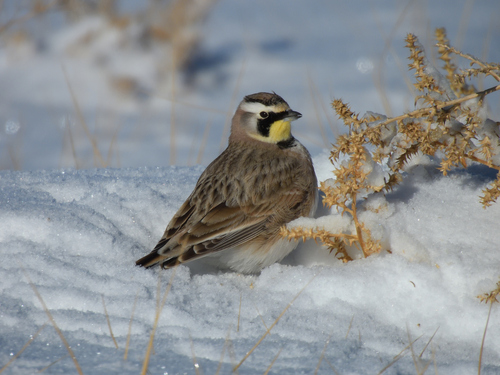 Shore Lark
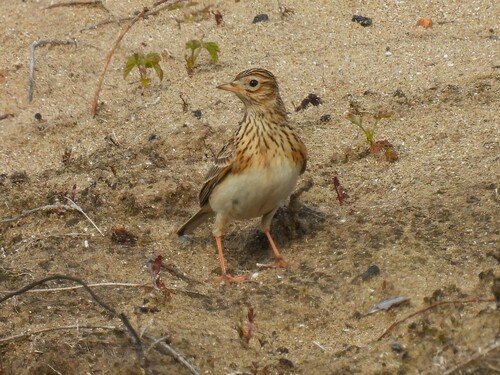 Eurasian Skylark
In short
The most reliable field mark to separate Shore Lark from Eurasian Skylark is the Shore Lark's striking black-and-yellow (or black-and-white in some races) face pattern, with black 'horns' on males, which is never shown by Eurasian Skylark. In flight, Shore Lark shows a strong contrast between its pale body and mostly black tail (except for the central feathers), while Eurasian Skylark has a duller, more uniform brown appearance with white edges to the tail and rear wing visible only when flying away. Skylark is bulkier, with a shorter tail and broader wings, and often raises a short crest when perched. Both species are similar in size, but their structure and plumage are distinct when seen well.
Identification tips
- Face pattern (all ages): Shore Lark always shows a striking face pattern with black and yellow (or white) markings; Eurasian Skylark's face is plain brown with no mask or bold markings.
- 'Horns' (adult male Shore Lark): Only Shore Lark males show black feather tufts ('horns') on the head in breeding plumage; Skylark never shows horns, only a short, blunt crest that can be raised or lowered.
- Tail pattern in flight (all ages): Shore Lark has a mostly black tail with only the central feathers pale, creating a strong contrast with the body, especially obvious in flight. Eurasian Skylark's tail is short, brown, and edged with white, with the white only visible when flying away.
- Upperwing and rear wing pattern: Eurasian Skylark shows white along the rear edge of the wing and tail, but only when flying away; Shore Lark lacks this feature and instead shows more contrast between the dark tail and pale body.
- Overall coloration: Shore Lark is paler below and greyer or brown-grey above, with a clear facial mask. Eurasian Skylark is dull brown above and pale below, with streaking but no strong contrast or mask.
- Crest vs. horns: Skylark may raise a short, blunt crest when alert or excited, but never shows the pointed 'horns' of Shore Lark males. Female Shore Larks and immatures lack horns but still show facial contrast.
- Structure: Skylark is bulkier, with a shorter tail and broader wings; Shore Lark is slimmer with a longer, more contrasting tail.
- Flight jizz: Skylark's flight is undulating or hovering, often high and prolonged; Shore Lark's flight is more direct and lower, with less hovering.
- Song: Skylark's song is a long, continuous, bubbling warble from high overhead; Shore Lark's song is short, weak, and tinkling, often given in short display flights.
- Habitat: Shore Lark prefers bare ground, shorelines, or tundra; Skylark is found in grassy fields, farmland, or heath.
- Perched posture: Skylark often appears rounder and may raise its crest; Shore Lark is slimmer, and males may show horns.
- Seasonal variation: Shore Lark males are most striking in summer with full horns and face mask; in winter, the mask may be duller but still present. Eurasian Skylark shows little seasonal change.
- Pitfalls: Immature Shore Larks may have a less bold face pattern, but still show some contrast and the black tail; Skylark juveniles are always plain-faced and lack tail contrast.
- Sex differences: Skylark males have broader wings for hovering, but this is subtle; Shore Lark males are more easily separated by their horns and mask.
- Regional variation: Southern European Shore Larks (E. a. penicillata) have a white (not yellow) face mask but still show the same pattern; Skylark is always plain-faced.
Size
Both species are similar in length: Shore Lark measures 16–20 cm and Eurasian Skylark 18–19 cm [wikipedia]. Skylark is slightly heavier on average, but the overlap is broad (Shore Lark: 28–48 g; Skylark: not specified here, but similar [avonet]). Wingspan is also close (Shore Lark: 30–34 cm). In the field, Skylark often appears bulkier and rounder, with a shorter tail and broader wings, especially in flight, while Shore Lark is slimmer with a longer, more contrasting tail.
Plumage
-
Juvenile/immature and adult non-breeding: Shore Lark of all ages shows a pale below, brown-grey above pattern, but even young birds have some facial contrast, and the tail is mostly black except for the central feathers—this creates a strong tail/body contrast in flight. Eurasian Skylark, regardless of age, is much duller: brown above, pale below, with no strong facial pattern and a short tail edged with white, especially visible from behind in flight. The rear edge of the Skylark's wings is also edged white, but this is only visible when flying away, not from the front or side.
-
Adult breeding male: Shore Lark males show black 'horns' (tufts) and a bold black-and-yellow (or black-and-white in some races) face mask. Eurasian Skylark males may show a short, blunt crest but never horns or a bold face mask. Both sexes of Skylark are similar, with the male having slightly broader wings.
-
Flight views: Shore Lark's black tail and pale body stand out, while Skylark looks more uniform, with white tail edges and rear wing only obvious when flying away.
Behaviour
Shore Lark often forages on the ground, sometimes in open, bare areas or shorelines, and is less likely to be seen performing extended song flights. Eurasian Skylark is famous for its long, high, hovering song flights, often singing for several minutes high above fields or heaths. On the ground, Skylark may raise its short crest, while Shore Lark rarely shows any crest except the male's 'horns.' Shore Lark males may perform short display flights with singing and diving, but not the prolonged hovering of Skylark.
Habitat
Shore Lark is typically found in open, bare ground, often near shorelines in winter (hence the European name), or in tundra and alpine habitats. Eurasian Skylark prefers open farmland, grassland, and heath, and is less tied to bare or stony ground. If you see a lark on a windswept shore or tundra, Shore Lark is more likely; in grassy fields or farmland, Skylark dominates.
Voice
Shore Lark gives high-pitched, lisping or tinkling calls and a weak song—typically a few chips followed by a short, ascending trill, often given in short flights. Eurasian Skylark's song is a long, bubbling, unbroken warble delivered during extended hovering flights, often lasting several minutes. If you hear a long, continuous song from high overhead, it's Skylark; Shore Lark's song is much shorter and less musical.