Spotted Redshank vs Ruff
Tringa erythropus versus Calidris pugnax
Play a quiz with Spotted Redshank and Ruff
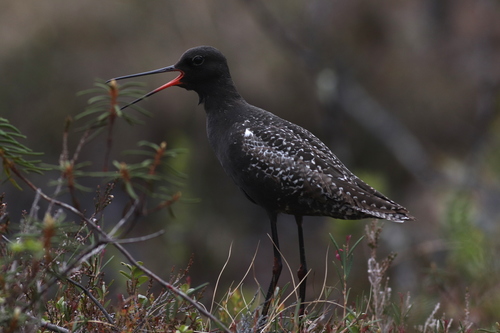 Spotted Redshank
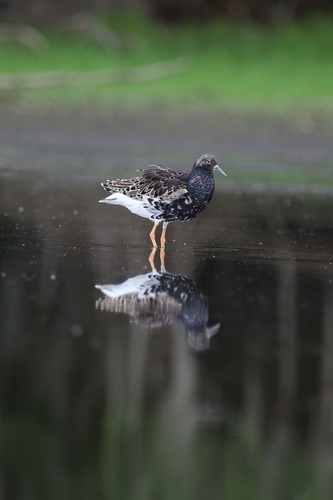 Ruff
In short
The most reliable field mark to separate Spotted Redshank from Ruff is the Spotted Redshank's bold white oval on the back visible in flight, present in all ages and seasons, while Ruff shows only faint white ovals on the sides of the tail and a thin, indistinct white wing bar. Juvenile and winter Ruff have a neat, scaly upperpart pattern and a pot-bellied, round-headed look, while Spotted Redshank juveniles are more finely speckled above and sleeker in build. Spotted Redshank adults in breeding plumage are strikingly blackish, unlike any Ruff. Structural differences are also key: Spotted Redshank is longer-legged, slimmer, and has a straight, fine, red-based bill, while Ruff is more compact with a thicker neck and variable leg color. Calls differ, but may be hard to use unless birds are vocalizing.
Identification tips
- White oval on back in flight (all ages): Spotted Redshank shows a bold white oval on the back, visible in all plumages and ages; Ruff lacks this, showing only faint white ovals at the tail sides and a thin, indistinct white wing bar.
- Juvenile upperpart pattern: Juvenile Ruff has a neat, scale-like pattern with dark feather centers and a buffy tinge below; Spotted Redshank juveniles are more finely speckled above and paler below, lacking the bold scaling.
- Overall structure: Spotted Redshank is taller, slimmer, with longer legs and neck, and a straight, fine bill with a red base; Ruff is pot-bellied, round-headed, with a shorter neck and a thicker, medium-length bill.
- Leg color: Spotted Redshank has red legs (turning dark grey in breeding plumage); Ruff's leg color is variable—pink, orange, or greenish, with some males showing reddish orange only in breeding season.
- Bill shape and color: Spotted Redshank's bill is straight, fine, and red-based; Ruff's bill is thicker, slightly downcurved in some birds, and lacks the strong red base.
- Breeding plumage: Spotted Redshank adults are strikingly blackish with white spots and dark legs; no Ruff is ever all-black. Ruff males develop elaborate ruffs and tufts, but females and non-breeding males are mottled grey-brown.
- Non-breeding plumage: Spotted Redshank is very pale with red legs and bill; Ruff is grey-brown above and paler below, with variable leg color.
- Flight style: Spotted Redshank flies with a sleek, direct action; Ruff has a deeper, slower wingbeat and appears heavier in flight.
- Group size: Spotted Redshank is usually solitary or in small groups; Ruff is highly gregarious, often in large flocks, especially outside the breeding season.
- Habitat preference: Spotted Redshank prefers open, wet habitats and is rarely found far from water; Ruff is more likely to be seen on wet grassland, marshes, or even agricultural fields.
- Voice: Spotted Redshank's creaking whistle 'teu-it' and sharp alarm are distinctive if heard; Ruff's calls are softer and less diagnostic.
- Sexual dimorphism: Ruff shows strong sexual dimorphism in breeding season, with males developing elaborate ruffs and tufts; Spotted Redshank does not.
- Moult timing: Ruff has a complex moult sequence, with males and females developing striped prebreeding plumage; Spotted Redshank moults completely between July and October, with juveniles undergoing a partial moult between August and February.
- Face pattern: Juvenile Ruff has a much plainer face compared to sharp-tailed and buff-breasted sandpipers, but compared to Spotted Redshank, the face is still more uniform and less contrasting.
- Potential pitfalls: Beware of non-breeding and juvenile birds, which can look similar at a distance; always look for the white back oval in flight for Spotted Redshank, and the pot-bellied, scaly look for juvenile Ruff.
Size
Both species are similar in overall size, but Spotted Redshank averages slightly heavier (151.5g vs 136.0g [wikidata]). Spotted Redshank is longer (29–31 cm) with a broader wingspan (61–67 cm), while female Ruff is smaller (22–26 cm, wingspan 46–49 cm). However, male Ruff can be larger and more variable, especially in breeding season. In the field, Spotted Redshank appears taller and more elongated due to its long legs and neck, whereas Ruff is pot-bellied, with a shorter neck and more rounded body.
Plumage
-
Juveniles and non-breeding birds: Spotted Redshank juveniles are grey-brown above, finely speckled with white, and have pale, finely barred underparts. Ruff juveniles have a neat, scale-like upperpart pattern with dark feather centers and a strong buff tinge below. This scaly pattern is diagnostic for juvenile Ruff, while Spotted Redshank is more evenly speckled and lacks the bold scaling.
-
In flight (all ages): Spotted Redshank shows a bold white oval on the back, a key mark in all plumages. Ruff has only faint white ovals on the sides of the tail and a thin, indistinct white wing bar, lacking the strong back oval of Spotted Redshank.
-
Adult breeding: Spotted Redshank turns mostly black with white spots and dark grey legs; no Ruff is ever all-black. Ruff males develop elaborate ruffs and tufts, but females and non-breeding males are mottled grey-brown with variable blotching and never approach the black of Spotted Redshank.
-
Adult non-breeding: Spotted Redshank is very pale, with red legs and bill, while Ruff is grey-brown above and paler below, with variable leg color (pink, orange, or greenish).
Behaviour
Spotted Redshank tends to be solitary or in small groups, often wading in deeper water, moving with a graceful, upright gait. Ruff is highly gregarious, especially outside the breeding season, forming large flocks and feeding in a more hunched, pot-bellied posture. In flight, Spotted Redshank is sleek and direct, while Ruff's flight is more labored, with deeper, slower wingbeats. Ruff males display elaborate courtship behavior in spring, but this is not a confusion risk with Spotted Redshank.
Habitat
Both species use wetland habitats, but Spotted Redshank favors open boggy taiga for breeding and is often seen in shallow water or muddy margins during migration and winter. Ruff breeds in marshes and wet meadows and is more likely to be found in large flocks on flooded fields, wet grasslands, or marshes. In winter, Ruff is more likely to be seen in agricultural or grassy habitats away from water, while Spotted Redshank remains tied to wetter, more open sites.
Voice
Spotted Redshank gives a creaking whistle 'teu-it' and an alarm 'kyip-kyip-kyip', somewhat reminiscent of a roseate tern. Ruff's calls are not described in detail here, but are generally softer and less distinctive. Vocalizations are not the most reliable separation unless calls are clearly heard, but Spotted Redshank's calls are sharper and more distinctive.