

Watercock vs White-breasted Waterhen
Gallicrex cinerea versus Amaurornis phoenicurus
Play a quiz with Watercock and White-breasted Waterhen
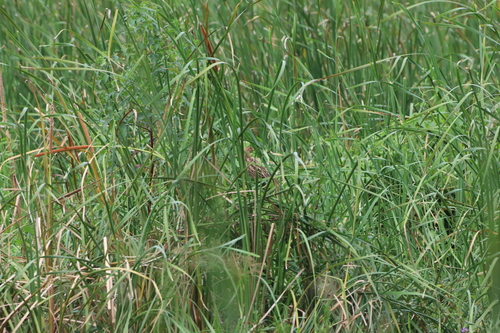 Watercock
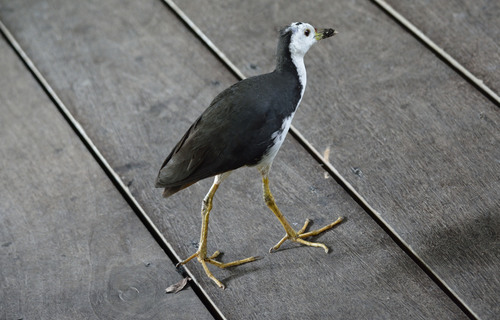 White-breasted Waterhen
In short
The most reliable field mark between Watercock and White-breasted Waterhen is the presence of a clean white face, neck, and breast on the adult White-breasted Waterhen, which is never shown by Watercock at any age. Watercock males are larger, darker, and have a distinctive red bill and frontal shield in breeding plumage, while females and immatures are streaked brown and lack white below. Both species are rails with laterally compressed bodies and long toes, but Watercock is bulkier and more secretive, while White-breasted Waterhen is bolder and often seen in the open with its tail cocked up. Juvenile and immature birds of both species are duller, but the Waterhen always shows some white on the face and underparts, which Watercock never does.
Identification tips
- White face, neck, and breast: Only White-breasted Waterhen shows a clean white face and underparts at all ages; Watercock never does. This is the single most reliable field mark.
- Bill and shield color (adult males): Breeding male Watercock has a bright red bill, frontal shield, and horn, which is never seen in Waterhen. Female Watercock and all Waterhens have yellow bills.
- Leg color: Watercock males have red legs; females and immatures have green legs. White-breasted Waterhen has yellow legs in adults.
- Body shape and size: Watercock is larger, bulkier, and more laterally compressed, especially in males. Waterhen is smaller, slimmer, and more compact.
- Plumage (female/immature Watercock): Female and immature Watercock are dark brown above, paler and streaked below, with no white on the face or breast. This can be confused with duller Waterhen immatures, but the latter always have some white on the face and underparts.
- Plumage (adult Waterhen): Always shows a sharp contrast between dark upperparts and white underparts; lower belly and undertail may be cinnamon or white.
- Tail posture: White-breasted Waterhen often walks with its tail cocked upright and jerks it as it moves; Watercock does not show this behavior as prominently.
- Habitat openness: Waterhen is more likely to be seen in open, disturbed, or urban wetlands, even near roads. Watercock is more secretive and prefers dense reedbeds.
- Behavior: Waterhen is bolder, often seen foraging in the open or climbing low vegetation. Watercock is shy and usually stays hidden.
- Vocalizations: Watercock's call is a loud gulping sound, mainly at dawn/dusk. Waterhen's call is harsh, sometimes roaring, and often repeated, sometimes described as 'ruak-ruak.'
- Sexual dimorphism: Watercock shows strong sexual dimorphism (males larger, darker, with red bill/shield), while Waterhen sexes are similar.
- Juvenile confusion: Both species have black downy chicks, but as they age, Waterhen juveniles always develop white on the face and breast, while Watercock juveniles remain buff to brown and never show white below.
- In flight: No distinctive upperwing pattern is noted for either species, but Waterhen may show contrast between dark upperparts and white underparts in flight, while Watercock appears uniformly dark or brownish depending on age/sex.
- Context: If seen with chicks, note chick color (both black) but look for adult association; Waterhen adults will always show white below, Watercock adults will not.
- Season and sex: Breeding male Watercock is unmistakable with its red bill/shield and dark plumage. Non-breeding, female, and immature Watercock are more easily confused with Waterhen, but lack of white on the face/breast remains diagnostic.
Size
Watercock is the larger and heavier species, with adult males reaching up to 43 cm in length and weighing 476–650 g, and females 36 cm and 298–434 g. The average body mass is about 403 g. In contrast, White-breasted Waterhen is smaller and lighter overall (precise mass not given, but consistently described as smaller than Watercock). Watercock appears bulkier and more robust, especially in males, while Waterhen is more slender and compact.
Plumage
- Juveniles and immatures: Both species have black downy chicks, but as they age, Watercock immatures are buff, darkening with age, and lack any white on the face or underparts. Immature White-breasted Waterhens are duller than adults but always show a white face, neck, and breast, even if less crisp than in adults.
- Adult males Watercock: Striking black-grey overall with a vivid red bill, frontal shield, and horn; no white on face or underparts. Legs are red.
- Adult females Watercock: Smaller, dark brown above, paler below, with streaked and barred plumage; yellow bill and green legs. No white face or breast.
- Adult White-breasted Waterhen: Dark slaty-grey upperparts and flanks, with a clean white face, neck, and breast. Lower belly and undertail are cinnamon or white. Bill and legs are yellow. Sexes similar.
- Key contrast: Only White-breasted Waterhen, at all ages, shows a white face and breast. Watercock never shows white in these areas.
Behaviour
White-breasted Waterhen is notably bolder and more likely to be seen in the open, often walking slowly with its tail cocked upright and foraging along the edge of waterbodies, sometimes even near human habitation. Watercock is much more secretive, usually staying hidden in dense reeds or undergrowth, but may occasionally venture into the open. Both species forage by probing mud or shallow water, but Waterhen is more likely to climb low vegetation and display its tail. Watercock's body is more laterally compressed, aiding movement through dense cover.
Habitat
Both species are found in marshes and wetland habitats across South and Southeast Asia. White-breasted Waterhen is more adaptable and frequently seen in open marshes, drains, and even near roads, sometimes at higher elevations. Watercock prefers dense reedbeds and is less likely to be seen in open or disturbed areas. If the bird is seen in a very open, disturbed, or urban wetland, Waterhen is more likely.
Voice
Watercock has a loud, gulping call, especially at dawn and dusk, which can be quite distinctive but is rarely heard unless the bird is nearby. White-breasted Waterhen is also noisy, with a harsh, sometimes roaring call followed by repeated clear notes, often described as onomatopoeic (ruak-ruak, etc.). Both can be quite vocal, but the Waterhen's call is more likely to be heard in open areas and is often described in local names.