

White-throated Blue Swallow vs Red-rumped Swallow
Hirundo nigrita versus Cecropis daurica
Play a quiz with White-throated Blue Swallow and Red-rumped Swallow
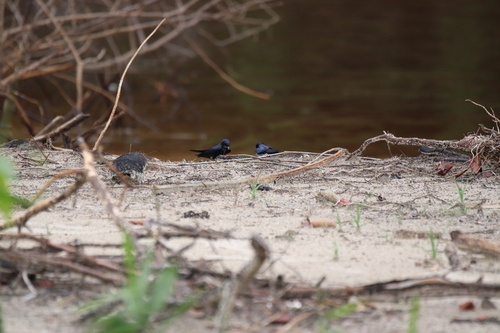 White-throated Blue Swallow
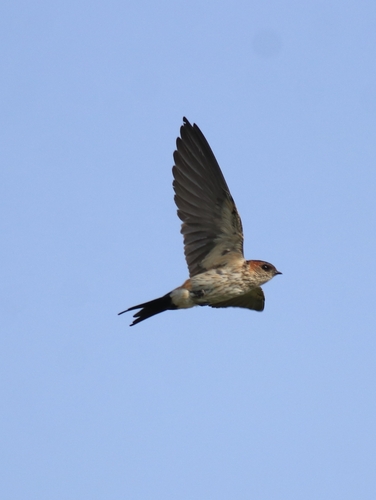 Red-rumped Swallow
In short
The most reliable field mark to separate these two swallows is the presence of a rich chestnut or reddish rump (and often a collar) on the Red-rumped Swallow, which is entirely absent in the White-throated Blue Swallow. Juvenile Red-rumped Swallows are duller and browner, but still show a pale or chestnut rump, while White-throated Blue Swallow is always glossy dark blue above (sometimes appearing black at a distance) with a crisp white throat and no rufous anywhere. In flight, the Red-rumped Swallow’s deeply forked tail and pale rump are distinctive, while the White-throated Blue Swallow is more uniformly dark with a white bib. Habitat also helps: White-throated Blue Swallow is tied to rainforest rivers and streams in Africa, while Red-rumped Swallow prefers open, hilly, or cultivated areas in Asia. Both are similar in size and structure, so focus on rump color and throat pattern for the quickest separation.
Identification tips
- Rump color is key: Red-rumped Swallow always shows a chestnut or reddish rump (sometimes streaked or paler in some subspecies/ages), visible both perched and in flight. White-throated Blue Swallow never shows any rufous or chestnut on the rump—always glossy dark blue or blackish.
- Throat and bib: White-throated Blue Swallow has a crisp, clean white throat and bib, sharply contrasting with the dark blue upperparts. Red-rumped Swallow has a white face and underparts, but these are heavily streaked with dark lines and lack a sharply defined white bib.
- Tail shape: Red-rumped Swallow has a deeply forked tail with long outer feathers (shorter in juveniles), while White-throated Blue Swallow’s tail is also forked but not as deeply, and lacks the same long streamers.
- Underpart streaking: Red-rumped Swallow shows heavy dark streaking on the white underparts, especially on the breast and flanks. White-throated Blue Swallow’s underparts are clean white (at least on the throat and bib), with no streaking.
- Upperpart gloss: White-throated Blue Swallow is glossy dark blue above, sometimes appearing black at a distance. Red-rumped Swallow is blue above but with a contrasting rufous rump and sometimes a rufous collar.
- Juvenile confusion: Juvenile Red-rumped Swallows are duller and browner, with a paler rump and shorter tail, but still show some pale or chestnut on the rump. Juvenile White-throated Blue Swallow is not described in detail, but all ages lack any rufous on the rump.
- Flight views: In flight, look for the Red-rumped Swallow’s pale or chestnut rump and long, forked tail. White-throated Blue Swallow appears more uniformly dark above, with a white throat patch visible from below.
- Habitat context: If you are near rainforest streams or rivers in Africa, White-throated Blue Swallow is possible. In open, hilly, or cultivated Asian landscapes, Red-rumped Swallow is much more likely.
- Geographic range: Red-rumped Swallow is found in Asia (from India to Taiwan), while White-throated Blue Swallow is restricted to the African tropical rainforest zone.
- Perched posture: Both species may perch on wires or branches, but Red-rumped Swallow often shows its rufous rump and streaked underparts when perched, while White-throated Blue Swallow shows a clean white throat and glossy blue upperparts.
- No rufous anywhere: If you see any rufous or chestnut on the rump or collar, rule out White-throated Blue Swallow.
- No heavy streaking: If the underparts are heavily streaked, it is a Red-rumped Swallow; White-throated Blue Swallow is clean below (at least on the throat and bib).
- No voice cues provided: Vocalizations are not described in the notes, so do not rely on calls or song for separation.
- Sexes similar: Both species have similar plumage in both sexes, so sex is not a useful field mark.
- Seasonal movement: White-throated Blue Swallow is generally resident; Red-rumped Swallow may be migratory or local migrant, but this is not a primary field mark.
Size
Both species are similar in overall size and structure, typical of medium-sized swallows. The Red-rumped Swallow is about 19 cm long with a deeply forked tail, while the White-throated Blue Swallow is also medium-sized, but precise measurements are not provided in the notes. No significant difference in size or mass is noted that would be useful for field separation.
Plumage
- Juvenile/immature birds: Juvenile Red-rumped Swallows are duller and browner than adults, with a paler or chestnut rump and shorter outer tail feathers, but always retain some pale or rufous on the rump. Juvenile White-throated Blue Swallows are not described in detail, but all ages are mainly glossy dark blue (sometimes appearing black), with a white throat and no rufous or chestnut tones anywhere.
- Adults: Adult Red-rumped Swallows have blue upperparts with a distinct reddish (chestnut) rump and sometimes a reddish collar, white underparts heavily streaked with dark, and a deeply forked tail. The White-throated Blue Swallow is glossy dark blue above, with a crisp white throat and bib, and no rufous or chestnut on the rump or collar. Its underparts are not streaked. In flight, the Red-rumped Swallow’s pale rump and forked tail are prominent, while the White-throated Blue Swallow appears more uniformly dark with a white throat patch.
Behaviour
Both species are aerial insectivores with typical swallow flight, but the White-throated Blue Swallow is generally resident and tied to watercourses in rainforest, while the Red-rumped Swallow is more migratory and often seen in open country, sometimes perched on wires or exposed branches. The Red-rumped Swallow may be seen in small groups, especially outside the breeding season. No major behavioral differences are described that would be diagnostic in the field beyond habitat context.
Habitat
Habitat is a strong supporting clue: White-throated Blue Swallow is found year-round near tropical rivers, lakes, and rainforest streams in the African tropical rainforest (including the Dahomey Gap), and is generally uncommon. Red-rumped Swallow is found in open, often hilly areas with clearings and cultivation across eastern and southeastern Asia to northeastern India and Taiwan. If you are in dense African rainforest by water, White-throated Blue Swallow is possible; in open Asian countryside, Red-rumped Swallow is far more likely.
White-throated Blue Swallow · Red-rumped Swallow · My Tricky Birds