

Yellow-crowned Tyrannulet vs Tropical Kingbird
Tyrannulus elatus versus Tyrannus melancholicus
Play a quiz with Yellow-crowned Tyrannulet and Tropical Kingbird
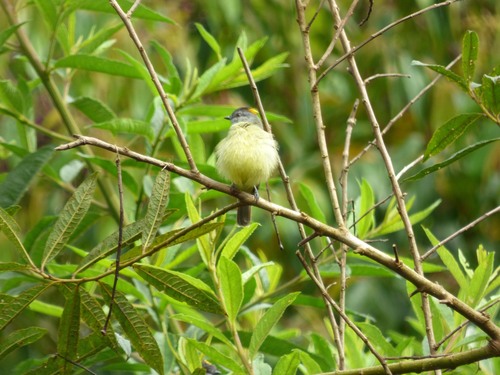 Yellow-crowned Tyrannulet
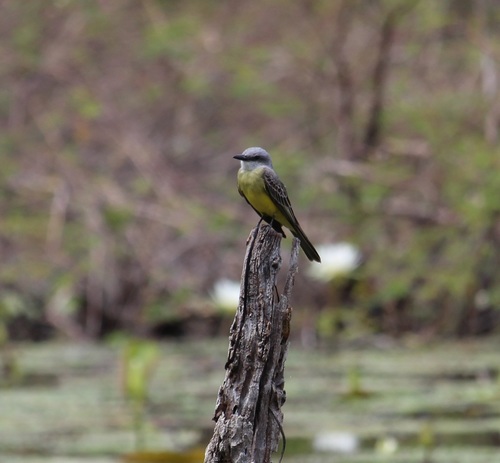 Tropical Kingbird
In short
The most reliable field mark to separate Yellow-crowned Tyrannulet from Tropical Kingbird is size and structure: the tyrannulet is a tiny, compact flycatcher with a short, rounded bill and a distinctive yellow crown stripe, while the kingbird is much larger, with a heavy, long bill and a pale gray head with a subtle orange crown stripe. In all ages, the kingbird shows a long, deeply forked tail and a robust, upright posture, contrasting with the tyrannulet’s short tail and more delicate jizz. Both have yellow underparts, but the kingbird’s head is much paler and its mask bolder. Immature kingbirds may show pale buff wing edges, but even young birds are far larger and bulkier than any tyrannulet.
Identification tips
- Size is the first check: If the bird is anywhere near the size of a sparrow or smaller, it cannot be a Tropical Kingbird. Kingbirds are large, bulky flycatchers; tyrannulets are tiny and delicate.
- Bill shape and size: Tyrannulet’s bill is short, rounded, and black; kingbird’s is long, heavy, and gray. Even at a distance, the kingbird’s bill looks thick and prominent.
- Tail shape: Kingbird’s tail is long and deeply forked, especially obvious when splayed or in flight. Tyrannulet’s tail is short, notched, and never forked.
- Crown stripe: Look for the bright yellow or orange-yellow crown stripe on the tyrannulet (especially in males); the kingbird’s orange crown stripe is rarely visible and the head looks pale gray overall.
- Head pattern: Tyrannulet has a grayish supercilium and a thin dark eye-line; kingbird has a bold dark mask and no strong supercilium.
- Underparts color: Both have yellow bellies, but tyrannulet’s is paler and more olive-washed on the breast, while kingbird’s is bright yellow sharply set off from a pale gray throat and breast.
- Wing bars: Tyrannulet always shows two crisp white to yellowish wing bars; kingbird’s wing bars are less distinct, but juveniles may show pale buff edges on the coverts.
- Juvenile/immature marks: Only young kingbirds have pale buff edges to the wing coverts; tyrannulets do not show this at any age.
- Perching behavior: Kingbirds perch high and exposed, often on wires or treetops; tyrannulets are more likely to be in mid-canopy or among foliage.
- Flight style: Kingbirds make long, acrobatic sallies and may hover; tyrannulets make short, direct flights.
- Habitat context: In very open, urban, or roadside habitats, kingbird is more likely; tyrannulet prefers woodland edge or denser vegetation.
- Vocalization: If you hear a high-pitched 'tree-e-e-e-e-e' trill, it is kingbird; tyrannulet’s voice is not described here.
- Sex differences: Female tyrannulets are slightly smaller and paler than males, but still much smaller than any kingbird.
- Iris and legs: Both have dark irises and gray to black legs, not a useful separator.
- Range overlap: Both can occur together in Central and northern South America, but kingbird is much more widespread in open and disturbed habitats.
Size
Yellow-crowned Tyrannulet is dramatically smaller, weighing about 7 g and measuring just 10–11 cm in length, compared to the Tropical Kingbird’s 37 g and 22 cm length. In the field, the kingbird appears nearly three times the mass of the tyrannulet and is much longer-bodied, with a noticeably larger head and bill. This size gap is obvious even at a distance or in mixed flocks.
Plumage
- Juvenile/immature wing pattern: Young Tropical Kingbirds show pale buff edges to the wing coverts, which can create a slightly 'scaly' look on the upperwing. Yellow-crowned Tyrannulet, in contrast, never shows this; its wing bars are always white to yellowish and crisp in all ages.
- Crown stripe: Tyrannulet has a bright yellow to orange-yellow crown stripe set in a darker (slate-gray to blackish) crown, especially in males. The kingbird’s crown stripe is orange but usually hidden, and the head is pale gray overall.
- Supercilium and mask: Tyrannulet has a grayish supercilium and a thin dark eye-line, while the kingbird has a bold, dark eye mask and no strong supercilium.
- Underparts: Both are yellow below, but the tyrannulet’s yellow is paler and more washed with olive on the breast, while the kingbird’s is brighter and more sharply demarcated from the pale gray throat and breast.
- Tail: Kingbird’s tail is long, brown, and deeply forked; tyrannulet’s is short, dusky olive, and notched but not forked.
- Bill: Tyrannulet has a short, rounded black bill; kingbird’s is heavy, long, and gray.
Behaviour
Tropical Kingbird is conspicuous, often perching high and sallying out on long, acrobatic flights to catch insects, sometimes hovering or chasing prey aggressively. It is territorial and will chase much larger birds. Yellow-crowned Tyrannulet is more retiring, foraging quietly in the mid- to upper canopy, making short sallies and rarely perching as prominently. Tyrannulets are less likely to be seen defending territory or engaging in aerial chases.
Habitat
Both species can occur in semi-open areas with trees, but Tropical Kingbird is more likely in open country, urban parks, roadsides, and gardens, often in very visible perches. Yellow-crowned Tyrannulet prefers forest edges, woodland, and more densely vegetated habitats, usually not as exposed as kingbirds. In Central and northern South America, kingbird is much more widespread and common in disturbed or open habitats.
Voice
Tropical Kingbird has a distinctive, high-pitched twittering trill, often rendered as 'tree-e-e-e-e-e,' and a more complex dawn song. Yellow-crowned Tyrannulet’s voice is not described in the notes, so vocalization is only a reliable separator if the kingbird’s call is heard.
Yellow-crowned Tyrannulet · Tropical Kingbird · My Tricky Birds