

Fiofío Caribeño vs Candelita Norteña
Elaenia martinica frente a Setophaga ruticilla
Juega un quiz con Fiofío Caribeño y Candelita Norteña
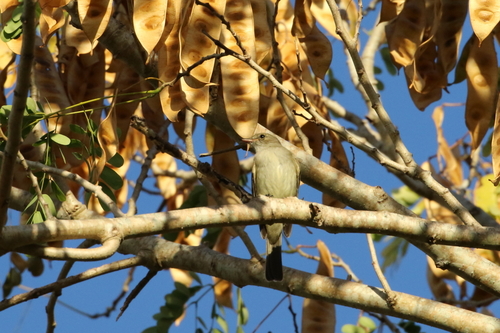 Fiofío Caribeño
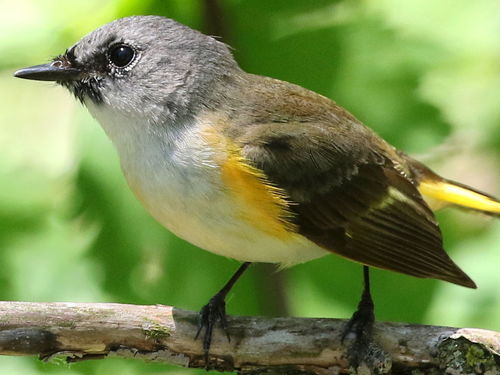 Candelita Norteña
En breve
The most reliable field mark to separate Caribbean Elaenia from American Redstart is the presence of bold, contrasting wing and tail patches in the redstart (especially adult males), versus the more subdued, olive-toned plumage with pale wing bars of the elaenia. Immature and female redstarts can be confusing, but look for the redstart’s habitually fanned tail with yellow or orange patches, and their smaller, slimmer build. Caribbean Elaenia is bulkier, with a bushy crest, pale lores, and two pale wing bars. Bill shape is also a strong clue: elaenia has a broader, flatter flycatcher bill, while redstart’s is finer and more pointed. Habitat and behavior can help, but plumage and structure are the safest cues.
Consejos de identificación
- Look for wing and tail patches: American Redstart (all ages/sexes) shows bright yellow (female/immature) or orange (adult male) patches in the tail and wings, visible when perched or in flight. Caribbean Elaenia never shows these patches—only pale wing bars.
- Check for a bushy crest: Caribbean Elaenia often raises a bushy crest with a faint white median stripe; American Redstart lacks a crest entirely.
- Bill shape: Elaenia has a broad, flat flycatcher bill with a dusky pinkish base to the mandible; redstart’s bill is finer, shorter, and more pointed, typical of a warbler.
- Wing bars vs. patches: Caribbean Elaenia has two pale wing bars (edges/tips of coverts), while redstart has no wing bars but instead has colored patches on the base of the primaries and tail.
- Tail behavior: Redstart frequently fans and flashes its tail, revealing colored patches; elaenia’s tail is dusky and not fanned or flashed in the same way.
- Overall coloration: Elaenia is olive to brownish olive above, with a pale gray throat and yellowish belly; redstart is black-and-orange (adult male) or olive/gray with yellow patches (female/immature), with white underparts.
- Facial pattern: Elaenia has whitish lores and a faint eyering; redstart’s face is plainer, with no strong lores or eyering.
- Size and structure: Elaenia is larger, bulkier, and has a bigger head and bill; redstart is smaller, slimmer, and more delicate.
- Leg color: Both have dark legs and feet; not a separator.
- Behavior: Redstart is much more active, constantly moving and foraging, while elaenia is more likely to sit upright and sally out for insects.
- Sex/age confusion: Immature and female redstarts can be confused with elaenia due to their duller plumage, but always look for yellow patches in wings/tail and more active behavior.
- Habitat context: If seen in dry scrub or edge habitat in the West Indies, elaenia is more likely; in moist woods or thickets, especially during migration/winter, redstart is more likely.
- Vocalizations: If you hear a musical 'see' song or soft 'chip', suspect redstart, but lack of voice is not diagnostic for elaenia.
- Crest and crown stripe: Only elaenia has a bushy crest with a pale median stripe; redstart never shows this feature.
- Plumage consistency: Both sexes and all ages of elaenia look similar; redstart shows strong sexual and age-related differences, but always retains colored wing/tail patches.
Tamaño
Caribbean Elaenia is noticeably larger and heavier (body mass ~21.3 g) than American Redstart (which averages about 8 g in adults). Elaenia measures 14–18 cm in length, while redstart is smaller at 11–14 cm. The elaenia is bulkier and more robust, with a proportionally larger head and thicker bill. Redstart is more delicate, with a relatively long tail for its size, but overall much lighter and slimmer.
Plumaje
-
Juvenile/First-year birds: Female and immature American Redstarts lack the adult male’s black-and-orange pattern, instead showing olive-green upperparts, grayish heads, and yellow patches in the wings and tail. These yellow patches are diagnostic at all ages and sexes, though sometimes less bright in young birds. Caribbean Elaenia of all ages lacks any wing or tail patches, instead showing two pale wing bars and dull olive to brownish-olive upperparts, with a bushy crest and a faint white median crown stripe.
-
Adults: Adult male American Redstarts are striking: jet black above with bold orange-red patches on wings, tail, and flanks, and white underparts. Females and immatures have yellow (not orange) patches but still show the same pattern. Caribbean Elaenia adults are much plainer, with no black or bright color, and always show a pale throat, pale yellowish belly, and olive upperparts. Both sexes of elaenia look alike.
-
In flight: Redstarts (all ages/sexes) show obvious flashes of yellow or orange in the tail and wings when fanned or in flight. Elaenia shows no such flashes, only pale edges to the flight feathers and two pale wing bars.
Comportamiento
American Redstart is a very active, restless forager, often flicking and fanning its tail to display the colored patches and flush insects. It frequently moves through foliage, making short flights and sallying after prey. Caribbean Elaenia is more deliberate, often perching upright and sallying out from a perch to catch insects, typical of flycatchers. It may raise its bushy crest when alert. Redstart’s constant tail fanning is a key behavioral clue.
Hábitat
Caribbean Elaenia is found in the West Indies, parts of Central America, and nearby islands, often in open woodland, scrub, and edge habitats. American Redstart breeds in open woodlands or scrub, often near water, and winters in the Caribbean and Central America. Overlap is possible in migration or winter, especially in the Caribbean, but elaenia is resident and more likely in drier or edge habitats, while redstart prefers moister woods and thickets during breeding and winter.
Voz
American Redstart gives a series of musical 'see' notes as its song, and a soft 'chip' as its call. Caribbean Elaenia’s vocalizations are not described in the provided notes, so voice is not a reliable separator here.