

Black-eared Barbet vs Gold-whiskered Barbet
Psilopogon duvaucelii versus Psilopogon chrysopogon
Play a quiz with Black-eared Barbet and Gold-whiskered Barbet
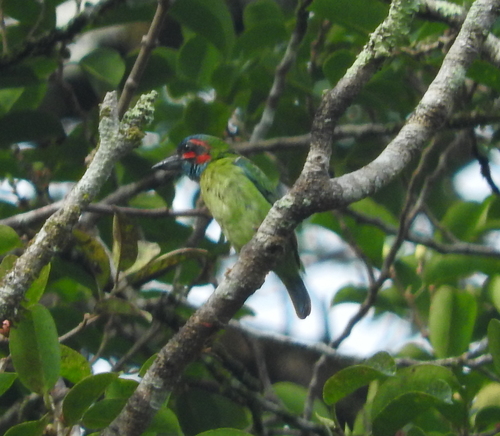 Black-eared Barbet
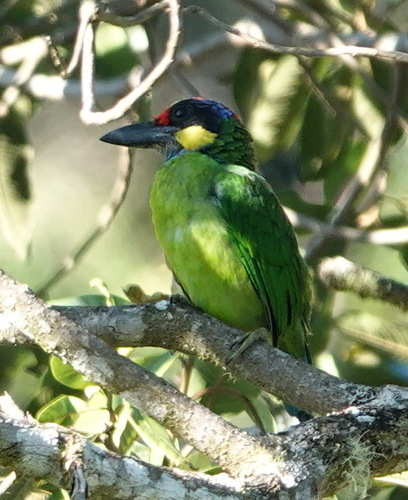 Gold-whiskered Barbet
In short
The most reliable field mark to separate Black-eared Barbet from Gold-whiskered Barbet is size: Gold-whiskered is dramatically larger and bulkier, with a noticeably heavier bill. In close views, Black-eared Barbet shows a distinctive black streak between the eyes and red spots below the eyes, while Gold-whiskered Barbet features a bold yellow moustachial stripe and a pale yellow forecrown. Both species are green overall with blue throats, but the facial pattern and proportions are strikingly different. Immature birds of both species are duller, but the size gap and facial markings remain useful.
Identification tips
- Size is the fastest check: Gold-whiskered Barbet is nearly twice as long and several times heavier than Black-eared Barbet. If the bird looks big and chunky, suspect Gold-whiskered.
- Bill size and color: Gold-whiskered has a large, thick bill (female's is paler bluish), while Black-eared's bill is smaller and black. This is visible even at a distance.
- Facial pattern (all ages): Black-eared Barbet shows a clear black streak between the eyes and red spots below the eyes, surrounded by black. Gold-whiskered lacks the black streak but has a bold yellow moustache ("whisker") and a pale yellow forecrown.
- Blue on face: Both have blue throats, but Gold-whiskered also has blue around the eyes and on the head, plus red patches near the bill. Black-eared's blue is limited to throat and nape.
- Red on face: Black-eared's red is restricted to spots below the eyes; Gold-whiskered has red patches on both sides of the beak and small red spots on the head.
- Moustachial stripe: Only Gold-whiskered Barbet has a strong yellow whisker running from the bill to the ear, a key field mark at any age.
- Forecrown color: Gold-whiskered has a pale yellow forecrown, contrasting with the green crown of Black-eared.
- Plumage brightness in immatures: Both species are duller when immature, but Gold-whiskered juveniles retain some yellow and blue facial tones; Black-eared's facial streak remains a good mark.
- Sex differences: Both are mostly similar, but female Gold-whiskered Barbets have a paler, dusky bluish bill. Black-eared shows no strong sexual dimorphism in the field.
- Habitat context: In shrubland or forest edge below 1,200 m, Black-eared is more likely. In dense forest, especially above 1,200 m, Gold-whiskered is more likely, but overlap is broad.
- Perched vs. in flight: No distinctive flight or wing pattern differences are described; rely on size and face.
- Group context: If you see a group and one bird is much smaller, it's likely Black-eared among Gold-whiskered, or vice versa.
- Bill color in females: If you see a pale, bluish bill, it's a female Gold-whiskered; Black-eared's bill is always black.
- Red below eye: If the red is only below the eye and surrounded by black, it's Black-eared; if red is on the sides of the beak, it's Gold-whiskered.
- When in doubt, size and face together: If you can't see the facial pattern well, use size as your primary clue, then look for the yellow whisker or black eye-streak as confirmation.
Size
Gold-whiskered Barbet is much larger (about 30 cm long, 110–215 g, average mass 151 g [wikidata]) compared to Black-eared Barbet (16–17 cm, 26.3–37 g [wikipedia]). This size difference is obvious in the field, especially if both are seen at the same time or near familiar objects. Gold-whiskered appears much bulkier, with a proportionally larger head and bill. Black-eared Barbet is compact and noticeably lighter, almost half the length and a fraction of the mass.
Plumage
No age-specific upperwing or flight pattern differences are described for either species; both are green overall and lack strong wing markings. For all ages, focus on the face: Black-eared Barbet has a black streak between the eyes, a black beak, and red spots below the eyes encircled by black. Its throat and nape are blue. Gold-whiskered Barbet has a yellow moustache extending to the ear, a pale yellow forecrown, blue throat, and blue around the eyes, with red patches on both sides of the beak. Immature Gold-whiskered Barbets are duller but retain the yellow whisker and blue facial tones; immature Black-eared Barbets are not described in detail but are expected to keep the black facial streak. Both sexes are similar, but female Gold-whiskered Barbets have a paler, dusky bluish bill.
Behaviour
No specific behavioral differences are described in the sources. Both species are typical barbets, often seen perched in the canopy or subcanopy and sometimes heard before seen. No differences in flight style or feeding behavior are noted.
Habitat
Both species overlap in range (Peninsular Malaysia, Sumatra, Borneo) and are found in forests, but Black-eared Barbet also uses shrubland and is found up to 1,200 m elevation, while Gold-whiskered Barbet is more strictly a forest bird and ranges up to 1,500 m. In mixed or edge habitats below 1,200 m, Black-eared Barbet is more likely, but habitat alone is not diagnostic where both occur.
Black-eared Barbet · Gold-whiskered Barbet · My Tricky Birds