

Blue-cheeked Bee-eater vs Sulphur-breasted Bushshrike
Merops persicus versus Chlorophoneus sulfureopectus
Play a quiz with Blue-cheeked Bee-eater and Sulphur-breasted Bushshrike
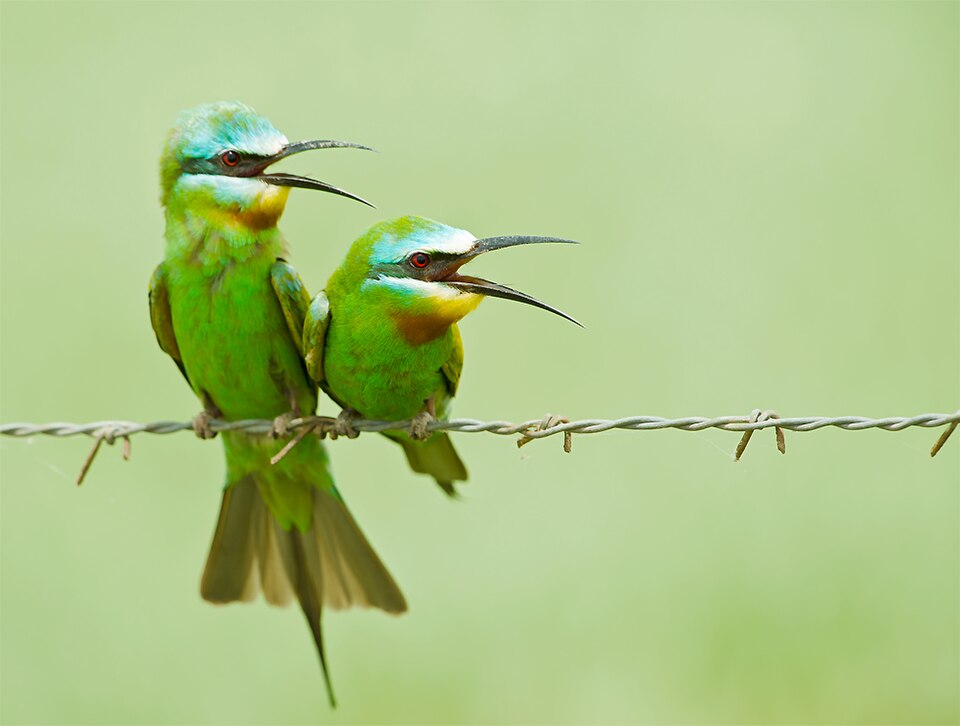 Blue-cheeked Bee-eater
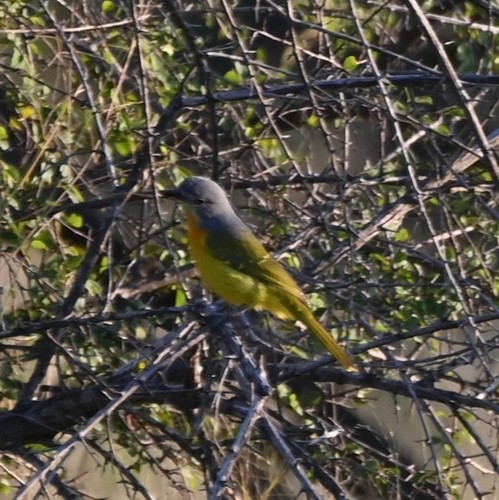 Sulphur-breasted Bushshrike
In short
The most reliable way to separate Blue-cheeked Bee-eater from Sulphur-breasted Bushshrike is by overall structure and coloration: the bee-eater is a slender, long-tailed, predominantly green bird with blue facial sides and a black eye-stripe, while the bushshrike is a more compact, robust bird with a striking orange or yellow breast but lacks the bee-eater’s blue face and elongated tail streamers. In flight or perched, the bee-eater’s long, pointed wings and deeply extended central tail feathers are diagnostic, especially in adults. Both species are colorful, but their shape, posture, and facial pattern are quite different. Habitat and behavior also help: bee-eaters are aerial hunters often seen sallying from wires, while bushshrikes are more skulking and perch within bushes or trees.
Identification tips
- Tail Shape and Length: Blue-cheeked Bee-eater has two elongated central tail feathers (streamers) that extend well beyond the rest of the tail, especially in adults. Sulphur-breasted Bushshrike has a short, square-tipped tail with no streamers. This is visible both perched and in flight.
- Facial Pattern: The bee-eater shows a distinct blue wash on the face with a sharp black eye-stripe; the bushshrike’s face is plain, lacking both blue and a strong eye-stripe.
- Bill Shape: Bee-eater’s bill is long, slender, and strongly decurved (downcurved), suited for catching insects in flight. Bushshrike’s bill is shorter, heavier, and hooked, adapted for grasping and manipulating prey in foliage.
- Overall Shape and Posture: Bee-eater is slender, with a long body, pointed wings, and an upright posture on exposed perches. Bushshrike is compact, with a robust body and a more horizontal, hunched posture, usually within cover.
- Breast Color: Bushshrike has a vivid orange to yellow breast, which is its most striking feature. Bee-eater’s throat is yellow and brown, but the breast and underparts are green, not orange or yellow.
- Upperparts Color: Both species have green upperparts, but bee-eater’s green is brighter and more uniform, while bushshrike’s green may be duller and restricted to the back.
- Flight Behavior: Bee-eater is highly aerial, often seen flying out from perches to catch insects, with buoyant, graceful flight. Bushshrike is rarely seen in sustained flight and usually moves through vegetation.
- Perching Behavior: Bee-eater prefers open, exposed perches like wires or bare branches. Bushshrike typically stays within dense foliage and is less likely to perch in the open.
- Habitat Preference: Bee-eater favors open country, semi-desert, and grassland, often near water. Bushshrike is found in bushy or wooded habitats, forest edges, or dense thickets.
- Sex Differences: Bee-eater sexes are similar, but females have shorter tail streamers. No strong sexual differences are noted for bushshrike in these notes.
- Group Size: Bee-eater may be seen in small colonies or loose groups, especially near breeding sites. Bushshrike is typically solitary or in pairs.
- Vocalization: If heard, bee-eater’s call is ‘flatter’ and less ‘fluty’ than European Bee-eater, but this is not a strong separator from bushshrike with current information.
- Bill Color: Bee-eater’s bill is black; bushshrike’s bill color is not described, but is typically dark in bushshrikes.
- Jizz in Flight: Bee-eater’s long, pointed wings and trailing streamers give a distinctive silhouette. Bushshrike’s flight is more direct and less buoyant, with a short tail and rounded wings.
- Pitfalls: Both are colorful and may show green upperparts, but only bee-eater combines blue cheeks, black eye-stripe, and long tail streamers. Only bushshrike has a bright orange/yellow breast with no blue on the face.
Size
Blue-cheeked Bee-eater is a medium-sized, slender bird (body mass ~49.4g), noticeably elongated by its long central tail feathers (total length up to 31 cm, with streamers adding up to 7 cm). Sulphur-breasted Bushshrike is not measured here, but is a more compact, sturdy passerine with a shorter tail and heavier build relative to its length. In the field, the bee-eater looks much longer and more streamlined, especially in flight, while the bushshrike appears chunky and short-tailed.
Plumage
No age-specific wing or flight pattern marks are described for either species in the sources, so focus is on adult plumage. Blue-cheeked Bee-eater is predominantly bright green with a blue wash on the face, a black eye-stripe, and a yellow and brown throat. Its two central tail feathers are elongated and extend well beyond the rest of the tail, especially in males. The bushshrike, in contrast, has a vivid orange to yellow breast (hence the name), but lacks blue on the face and has no black eye-stripe. Its upperparts are typically greenish, but the face is plain, and the tail is short and square-tipped. Both sexes of bee-eater are similar, though females have shorter tail streamers; bushshrike sexual dimorphism is not detailed, but both sexes share the orange/yellow breast. The bee-eater’s black bill is long and decurved, while the bushshrike’s bill is shorter and hooked.
Behaviour
Blue-cheeked Bee-eater is highly aerial, often seen sallying out from exposed perches (like wires) to catch flying insects, and may be seen in loose groups or colonies. It is conspicuous in open areas, frequently perching in the open. Sulphur-breasted Bushshrike is more retiring, usually foraging within dense bushes or trees, and is less likely to be seen in the open. It tends to be solitary or in pairs, moving methodically through foliage rather than hawking insects in the air.
Habitat
Blue-cheeked Bee-eater breeds in semi-desert with scattered trees (acacia), and winters in open woodland or grassland, often near water. It is usually found in open, sunny habitats and is rarely deep in dense vegetation. Sulphur-breasted Bushshrike prefers bushy or wooded habitats, often within thickets or forest edges, and is less likely to be found in open country. If the bird is in a dense bush or forest edge, bushshrike is more likely; if it is in the open or on wires, bee-eater is favored.
Voice
Blue-cheeked Bee-eater’s call is described as ‘flatter’ and less ‘fluty’ than European Bee-eater, but no direct comparison to bushshrike is given. No vocal description is provided for Sulphur-breasted Bushshrike in these notes. Therefore, voice is not a reliable separator with the information at hand.
Blue-cheeked Bee-eater · Sulphur-breasted Bushshrike · My Tricky Birds