
Motmot

Denham's Bustard vs African Paradise-Flycatcher

Neotis denhami versus Terpsiphone viridis

Play a quiz with Denham's Bustard and African Paradise-Flycatcher
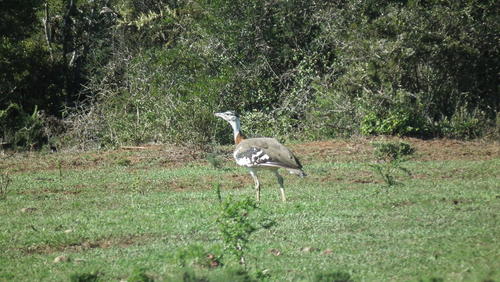
Denham's Bustard (Neotis denhami) Denham's Bustard
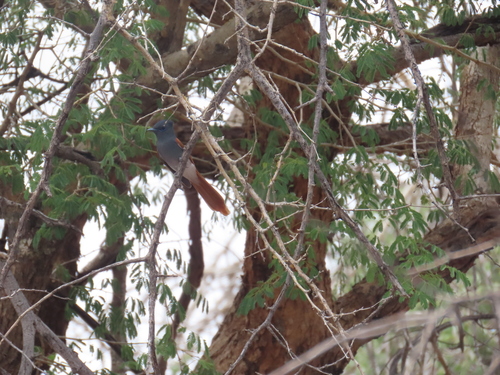
African Paradise-Flycatcher (Terpsiphone viridis) African Paradise-Flycatcher

Media

Loading…

In short

Denham's Bustard and African Paradise-Flycatcher are dramatically different in size, structure, and flight style, but confusion may arise with distant or brief views, especially of females or immatures. The most reliable field mark is overall size and shape: Denham's Bustard is a massive, long-legged ground bird with a heavy build, while African Paradise-Flycatcher is a slender, small songbird, often with long tail streamers in males. In flight, Denham's Bustard shows bold white, brown, and black wing patterns (especially in adult males), whereas the flycatcher has chestnut wings with a white wingbar (in adult males) and a much more delicate, fluttery flight. Habitat overlap is possible in open country, but their behavior and jizz are distinct. Vocalizations are also a strong separator: the flycatcher is noisy and scolding, while the bustard is usually silent.

Identification tips

  1. Size and shape: Denham's Bustard is massive, with long legs and a heavy, upright stance; African Paradise-Flycatcher is small, slender, and perches upright with a delicate build. Size alone is diagnostic except at extreme distance.
  2. Flight style: Bustard flies with slow, deep wingbeats and broad wings, often low over the ground; flycatcher has a fluttery, agile, and much lighter flight, often sallying from perches.
  3. Tail: Male flycatcher has extremely long, narrow tail streamers (more than twice body length); bustard has a broad, short tail relative to body size. Female flycatcher has a medium-length tail, still much shorter than bustard's bulk.
  4. Wing pattern in flight: Adult male Denham's Bustard shows bold white, brown, and black on the wings, with extensive white panels; females and juveniles have less white. Flycatcher male has a small white wingbar on chestnut wings; female lacks wingbar.
  5. Plumage (perched): Bustard has a pale grey neck with orange nape, brown back, white underparts, and black-and-white facial pattern. Flycatcher male is chestnut above, glossy black head and underparts, white wingbar; female is browner, paler below, lacks wingbar.
  6. Leg color: Bustard has long, pale yellow legs; flycatcher has short, dark legs (often not visible in the field).
  7. Bill: Bustard has a thick, pale horn-colored bill; flycatcher has a small, thin, dark bill suited for catching insects.
  8. Behavior: Bustard walks on the ground, rarely perches; flycatcher is almost always perched or flitting in trees and shrubs.
  9. Voice: Flycatcher is noisy, with harsh scolding calls; bustard is almost always silent.
  10. Habitat context: Bustard in open grassland or agricultural fields, always on the ground; flycatcher in woodland, forest edge, or savanna, usually above ground.
  11. Sex/age pitfalls: Female and juvenile flycatchers lack streamers and are duller, but still much smaller and more arboreal than any bustard. Female and young bustards are browner and less boldly marked than males, but still huge and ground-dwelling.
  12. Courtship display: Only bustard inflates throat and struts with white balloon of feathers; flycatcher displays by fanning tail and fluttering, but never with throat inflation.
  13. Feeding behavior: Bustard forages on ground for insects, small vertebrates, and plants; flycatcher catches insects in flight or gleans from foliage.
  14. Mixed flocks: Flycatcher may join mixed-species flocks in woodland; bustard is solitary or in small groups, never in mixed flocks.
  15. Confusion risk: Only likely with distant, poorly seen birds, or with female/immature flycatchers lacking streamers. Always check for size, habitat, and behavior first.

Size

Denham's Bustard is among the largest African landbirds, with males reaching 100–116 cm (39–46 in) in length and weighing 9–10 kg (20–22 lb), and females still large at 80–87 cm (31–34 in) and 3–4 kg (6.6–8.8 lb) [wikipedia, avonet]. In contrast, the African Paradise-Flycatcher is a small passerine: males are about 17 cm (6.7 in) in body length, but with tail streamers can appear up to 34 cm (13 in); females are similar in body size but lack streamers. The bustard is bulkier than any raptor or stork, while the flycatcher is smaller than a thrush and much lighter in build.

Plumage

Juvenile and female Denham's Bustards are plainer brown above and white below, with less white in the wings than adult males. In flight, adult male Denham's Bustard shows a striking pattern of brown, white, and black on the wings, with the white most prominent in males; females and young birds have less white and a duller pattern. The African Paradise-Flycatcher adult male is chestnut above with a black head and underparts, a white wingbar, and long tail streamers; females are browner, lack the wingbar and streamers, and are duller overall. Juvenile flycatchers resemble females but are even less vibrant. The bustard's pale grey neck with orange nape and black-and-white facial pattern is unique, while the flycatcher's glossy black head (male) or paler brown head (female) and blue-grey underparts are distinctive at close range. There is no overlap in wing pattern: bustards have bold, blocky wing markings, while flycatchers have a small, neat white wingbar (males only).

Behaviour

Denham's Bustard is usually solitary or in small groups, walking slowly on the ground in open grassland or agricultural fields, and rarely perches. Its flight is heavy and direct, with broad wings and slow wingbeats. During courtship, the male inflates his throat and struts with a conspicuous white balloon of feathers. African Paradise-Flycatcher is active, restless, and often seen sallying for insects from perches, with a fluttery, agile flight. It perches upright, often in mid-level branches, and is much more arboreal. The flycatcher is noisy and conspicuous, while the bustard is generally silent and wary.

Habitat

Both species can occur in open habitats, but Denham's Bustard favors open grasslands, floodplains, and sometimes agricultural land, rarely venturing into dense woodland. It may be found at elevations up to 3,000 m. African Paradise-Flycatcher prefers open forest, woodland edges, and savanna, and is more likely to be found in trees or shrubs. While both may be present in savanna mosaics, the bustard is always on the ground, while the flycatcher is almost always in trees or bushes.

Voice

Denham's Bustard is usually silent, even during display, though males may call softly when displaying. African Paradise-Flycatcher is noisy, with a harsh, scolding call that is often heard before the bird is seen. If you hear a loud, repeated scold or chatter, it is almost certainly the flycatcher.

Submit a better description

Use the same sections as the comparison. Your text is published immediately.

Denham's Bustard and African Paradise-Flycatcher are dramatically different in size, structure, and flight style, but confusion may arise with distant or brief views, especially of females or immatures. The most reliable field mark is overall size and shape: Denham's Bustard is a massive, long-legged ground bird with a heavy build, while African Paradise-Flycatcher is a slender, small songbird, often with long tail streamers in males. In flight, Denham's Bustard shows bold white, brown, and black wing patterns (especially in adult males), whereas the flycatcher has chestnut wings with a white wingbar (in adult males) and a much more delicate, fluttery flight. Habitat overlap is possible in open country, but their behavior and jizz are distinct. Vocalizations are also a strong separator: the flycatcher is noisy and scolding, while the bustard is usually silent.

  1. Size and shape: Denham's Bustard is massive, with long legs and a heavy, upright stance; African Paradise-Flycatcher is small, slender, and perches upright with a delicate build. Size alone is diagnostic except at extreme distance.
  2. Flight style: Bustard flies with slow, deep wingbeats and broad wings, often low over the ground; flycatcher has a fluttery, agile, and much lighter flight, often sallying from perches.
  3. Tail: Male flycatcher has extremely long, narrow tail streamers (more than twice body length); bustard has a broad, short tail relative to body size. Female flycatcher has a medium-length tail, still much shorter than bustard's bulk.
  4. Wing pattern in flight: Adult male Denham's Bustard shows bold white, brown, and black on the wings, with extensive white panels; females and juveniles have less white. Flycatcher male has a small white wingbar on chestnut wings; female lacks wingbar.
  5. Plumage (perched): Bustard has a pale grey neck with orange nape, brown back, white underparts, and black-and-white facial pattern. Flycatcher male is chestnut above, glossy black head and underparts, white wingbar; female is browner, paler below, lacks wingbar.
  6. Leg color: Bustard has long, pale yellow legs; flycatcher has short, dark legs (often not visible in the field).
  7. Bill: Bustard has a thick, pale horn-colored bill; flycatcher has a small, thin, dark bill suited for catching insects.
  8. Behavior: Bustard walks on the ground, rarely perches; flycatcher is almost always perched or flitting in trees and shrubs.
  9. Voice: Flycatcher is noisy, with harsh scolding calls; bustard is almost always silent.
  10. Habitat context: Bustard in open grassland or agricultural fields, always on the ground; flycatcher in woodland, forest edge, or savanna, usually above ground.
  11. Sex/age pitfalls: Female and juvenile flycatchers lack streamers and are duller, but still much smaller and more arboreal than any bustard. Female and young bustards are browner and less boldly marked than males, but still huge and ground-dwelling.
  12. Courtship display: Only bustard inflates throat and struts with white balloon of feathers; flycatcher displays by fanning tail and fluttering, but never with throat inflation.
  13. Feeding behavior: Bustard forages on ground for insects, small vertebrates, and plants; flycatcher catches insects in flight or gleans from foliage.
  14. Mixed flocks: Flycatcher may join mixed-species flocks in woodland; bustard is solitary or in small groups, never in mixed flocks.
  15. Confusion risk: Only likely with distant, poorly seen birds, or with female/immature flycatchers lacking streamers. Always check for size, habitat, and behavior first.

Denham's Bustard is among the largest African landbirds, with males reaching 100–116 cm (39–46 in) in length and weighing 9–10 kg (20–22 lb), and females still large at 80–87 cm (31–34 in) and 3–4 kg (6.6–8.8 lb) [wikipedia, avonet]. In contrast, the African Paradise-Flycatcher is a small passerine: males are about 17 cm (6.7 in) in body length, but with tail streamers can appear up to 34 cm (13 in); females are similar in body size but lack streamers. The bustard is bulkier than any raptor or stork, while the flycatcher is smaller than a thrush and much lighter in build.

Juvenile and female Denham's Bustards are plainer brown above and white below, with less white in the wings than adult males. In flight, adult male Denham's Bustard shows a striking pattern of brown, white, and black on the wings, with the white most prominent in males; females and young birds have less white and a duller pattern. The African Paradise-Flycatcher adult male is chestnut above with a black head and underparts, a white wingbar, and long tail streamers; females are browner, lack the wingbar and streamers, and are duller overall. Juvenile flycatchers resemble females but are even less vibrant. The bustard's pale grey neck with orange nape and black-and-white facial pattern is unique, while the flycatcher's glossy black head (male) or paler brown head (female) and blue-grey underparts are distinctive at close range. There is no overlap in wing pattern: bustards have bold, blocky wing markings, while flycatchers have a small, neat white wingbar (males only).

Denham's Bustard is usually solitary or in small groups, walking slowly on the ground in open grassland or agricultural fields, and rarely perches. Its flight is heavy and direct, with broad wings and slow wingbeats. During courtship, the male inflates his throat and struts with a conspicuous white balloon of feathers. African Paradise-Flycatcher is active, restless, and often seen sallying for insects from perches, with a fluttery, agile flight. It perches upright, often in mid-level branches, and is much more arboreal. The flycatcher is noisy and conspicuous, while the bustard is generally silent and wary.

Both species can occur in open habitats, but Denham's Bustard favors open grasslands, floodplains, and sometimes agricultural land, rarely venturing into dense woodland. It may be found at elevations up to 3,000 m. African Paradise-Flycatcher prefers open forest, woodland edges, and savanna, and is more likely to be found in trees or shrubs. While both may be present in savanna mosaics, the bustard is always on the ground, while the flycatcher is almost always in trees or bushes.

Denham's Bustard is usually silent, even during display, though males may call softly when displaying. African Paradise-Flycatcher is noisy, with a harsh, scolding call that is often heard before the bird is seen. If you hear a loud, repeated scold or chatter, it is almost certainly the flycatcher.

Discard your changes?

You have unsaved edits. If you leave now, those changes will be lost.

Denham's Bustard · African Paradise-Flycatcher · My Tricky Birds