
Motmot

Green-throated Carib vs Shiny Cowbird

Eulampis holosericeus versus Molothrus bonariensis

Play a quiz with Green-throated Carib and Shiny Cowbird
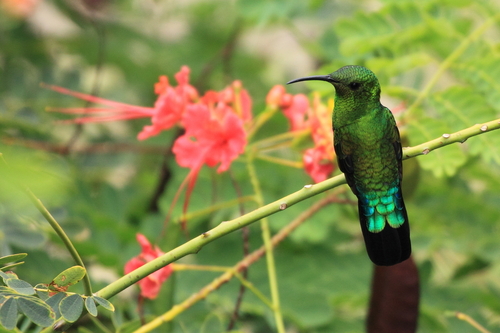
Green-throated Carib (Eulampis holosericeus) Green-throated Carib
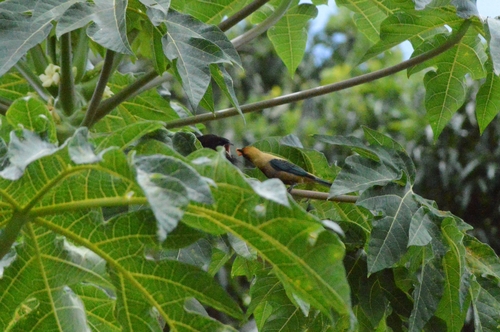
Shiny Cowbird (Molothrus bonariensis) Shiny Cowbird

Media

Loading…

In short

The most reliable field mark to separate Green-throated Carib from Shiny Cowbird is overall structure and plumage: the carib is a large, robust hummingbird with a glittering green throat and back, while the cowbird is a much larger, stocky songbird with a straight bill and sexually dimorphic plumage (males glossy black, females dull brown). In flight or perched, the carib’s decurved bill and iridescent green gorget are diagnostic, whereas the cowbird’s straight bill and lack of iridescent green rule out confusion. Size difference is extreme: the cowbird is about six times heavier and much longer. If you see a bird feeding at flowers or hovering, it is the carib; if it is walking on the ground or foraging in open areas, it is the cowbird.

Identification tips

  1. Bill shape: Green-throated Carib has a medium-length, slightly decurved bill (female even longer and more curved); Shiny Cowbird has a straight, conical bill. Bill shape is a quick separator even at distance.
  2. Size: Cowbird is much larger and heavier (about 6x the mass of the carib). If the bird looks sparrow-sized or larger, it is not a carib.
  3. Plumage (male carib): Bright green back and gorget, black belly, and blue-black tail. No cowbird shows this combination.
  4. Plumage (female carib): Duller green back and gorget, but still metallic; longer, more curved bill. Cowbird females are never green or iridescent.
  5. Plumage (male cowbird): Entirely glossy black with purple-blue iridescence, never green. Carib never appears all-black or purple.
  6. Plumage (female cowbird): Dull brown overall, sometimes paler below, with no iridescence. Can be confused with other cowbirds, but not with any carib.
  7. Flight style: Carib hovers frequently and moves with rapid, darting flight; cowbird flies directly and does not hover.
  8. Feeding behavior: Carib feeds at flowers, often hovering; cowbird forages on the ground or in low vegetation, never at flowers.
  9. Tail: Carib’s tail is dark blue (often looks black), short and squared; cowbird’s tail is longer, not iridescent, and more typical of a songbird.
  10. Habitat context: Carib is usually seen where there are flowering shrubs or trees; cowbird is more likely in open, grassy, or agricultural areas.
  11. Voice: Carib gives sharp 'chup!' or 'chuwp!' calls; cowbird’s vocalizations are more songbird-like and include display songs.
  12. Sexual dimorphism: Cowbird is strongly dimorphic (males black, females brown); carib sexes are similar (both green, female duller).
  13. Perching posture: Carib perches upright, often on exposed twigs near flowers; cowbird perches more horizontally, often in flocks.
  14. Brood parasitism: Only cowbird is a brood parasite; carib is not associated with other birds’ nests.
  15. Pitfalls: Female cowbird might superficially resemble a dull, non-iridescent bird, but bill shape and lack of green or blue quickly rule out carib. Young or molting birds are not described in detail but should follow the same structural and behavioral differences.

Size

Green-throated Carib is a small hummingbird (6.2 g), while Shiny Cowbird is a medium-sized passerine (37 g). The cowbird is much bulkier and longer (up to 22 cm in some subspecies) compared to the carib’s 10.5–12 cm. Even at a distance, the cowbird’s size and proportions (especially in flight or on the ground) are far more substantial than the delicate, compact carib.

Plumage

No age-specific wing or flight pattern marks are described for either species, so focus is on adult and female/immature plumage. Green-throated Carib of all ages and sexes shows a bright green back and gorget, black belly, green vent, and a dark blue tail that may look black in poor light. Females are duller but still green above, with a longer, more decurved bill. Shiny Cowbird males are glossy black with purple-blue iridescence; females are dull brown, sometimes paler below, with no iridescence or green. The cowbird’s plumage is never metallic green or blue-green, and females can be confused with other cowbirds but not with a carib. No immature or juvenile wing pattern is mentioned for either species.

Behaviour

Green-throated Carib hovers at flowers and feeds on nectar, often defending feeding territories. It may also sally for insects. Shiny Cowbird forages mostly on the ground or in low vegetation, searching for seeds and insects, and is often seen walking or hopping rather than hovering. The carib’s flight is rapid and agile, typical of hummingbirds, while the cowbird’s flight is more direct and less acrobatic. Cowbirds are brood parasites and may be seen near other birds’ nests, but this is rarely observed directly.

Habitat

Green-throated Carib is found in Puerto Rico and the Lesser Antilles, mainly in gardens, second growth, and vegetation around homes. Shiny Cowbird is widespread in South America and the Caribbean, favoring open habitats, agricultural land, and disturbed areas. Both can be found in human-modified environments, but the carib is more closely tied to flowering vegetation, while the cowbird prefers open, grassy, or agricultural settings.

Voice

Green-throated Carib gives a sharp 'chup!' or 'chuwp!' call, and may produce rattles and wing whirs during disputes. Shiny Cowbird males sing during courtship, with a display song and bowing, but no specific call is described for field separation. The carib’s calls are sharper and more typical of hummingbirds, while the cowbird’s vocalizations are more songbird-like.

Submit a better description

Use the same sections as the comparison. Your text is published immediately.

The most reliable field mark to separate Green-throated Carib from Shiny Cowbird is overall structure and plumage: the carib is a large, robust hummingbird with a glittering green throat and back, while the cowbird is a much larger, stocky songbird with a straight bill and sexually dimorphic plumage (males glossy black, females dull brown). In flight or perched, the carib’s decurved bill and iridescent green gorget are diagnostic, whereas the cowbird’s straight bill and lack of iridescent green rule out confusion. Size difference is extreme: the cowbird is about six times heavier and much longer. If you see a bird feeding at flowers or hovering, it is the carib; if it is walking on the ground or foraging in open areas, it is the cowbird.

  1. Bill shape: Green-throated Carib has a medium-length, slightly decurved bill (female even longer and more curved); Shiny Cowbird has a straight, conical bill. Bill shape is a quick separator even at distance.
  2. Size: Cowbird is much larger and heavier (about 6x the mass of the carib). If the bird looks sparrow-sized or larger, it is not a carib.
  3. Plumage (male carib): Bright green back and gorget, black belly, and blue-black tail. No cowbird shows this combination.
  4. Plumage (female carib): Duller green back and gorget, but still metallic; longer, more curved bill. Cowbird females are never green or iridescent.
  5. Plumage (male cowbird): Entirely glossy black with purple-blue iridescence, never green. Carib never appears all-black or purple.
  6. Plumage (female cowbird): Dull brown overall, sometimes paler below, with no iridescence. Can be confused with other cowbirds, but not with any carib.
  7. Flight style: Carib hovers frequently and moves with rapid, darting flight; cowbird flies directly and does not hover.
  8. Feeding behavior: Carib feeds at flowers, often hovering; cowbird forages on the ground or in low vegetation, never at flowers.
  9. Tail: Carib’s tail is dark blue (often looks black), short and squared; cowbird’s tail is longer, not iridescent, and more typical of a songbird.
  10. Habitat context: Carib is usually seen where there are flowering shrubs or trees; cowbird is more likely in open, grassy, or agricultural areas.
  11. Voice: Carib gives sharp 'chup!' or 'chuwp!' calls; cowbird’s vocalizations are more songbird-like and include display songs.
  12. Sexual dimorphism: Cowbird is strongly dimorphic (males black, females brown); carib sexes are similar (both green, female duller).
  13. Perching posture: Carib perches upright, often on exposed twigs near flowers; cowbird perches more horizontally, often in flocks.
  14. Brood parasitism: Only cowbird is a brood parasite; carib is not associated with other birds’ nests.
  15. Pitfalls: Female cowbird might superficially resemble a dull, non-iridescent bird, but bill shape and lack of green or blue quickly rule out carib. Young or molting birds are not described in detail but should follow the same structural and behavioral differences.

Green-throated Carib is a small hummingbird (6.2 g), while Shiny Cowbird is a medium-sized passerine (37 g). The cowbird is much bulkier and longer (up to 22 cm in some subspecies) compared to the carib’s 10.5–12 cm. Even at a distance, the cowbird’s size and proportions (especially in flight or on the ground) are far more substantial than the delicate, compact carib.

No age-specific wing or flight pattern marks are described for either species, so focus is on adult and female/immature plumage. Green-throated Carib of all ages and sexes shows a bright green back and gorget, black belly, green vent, and a dark blue tail that may look black in poor light. Females are duller but still green above, with a longer, more decurved bill. Shiny Cowbird males are glossy black with purple-blue iridescence; females are dull brown, sometimes paler below, with no iridescence or green. The cowbird’s plumage is never metallic green or blue-green, and females can be confused with other cowbirds but not with a carib. No immature or juvenile wing pattern is mentioned for either species.

Green-throated Carib hovers at flowers and feeds on nectar, often defending feeding territories. It may also sally for insects. Shiny Cowbird forages mostly on the ground or in low vegetation, searching for seeds and insects, and is often seen walking or hopping rather than hovering. The carib’s flight is rapid and agile, typical of hummingbirds, while the cowbird’s flight is more direct and less acrobatic. Cowbirds are brood parasites and may be seen near other birds’ nests, but this is rarely observed directly.

Green-throated Carib is found in Puerto Rico and the Lesser Antilles, mainly in gardens, second growth, and vegetation around homes. Shiny Cowbird is widespread in South America and the Caribbean, favoring open habitats, agricultural land, and disturbed areas. Both can be found in human-modified environments, but the carib is more closely tied to flowering vegetation, while the cowbird prefers open, grassy, or agricultural settings.

Green-throated Carib gives a sharp 'chup!' or 'chuwp!' call, and may produce rattles and wing whirs during disputes. Shiny Cowbird males sing during courtship, with a display song and bowing, but no specific call is described for field separation. The carib’s calls are sharper and more typical of hummingbirds, while the cowbird’s vocalizations are more songbird-like.

Discard your changes?

You have unsaved edits. If you leave now, those changes will be lost.

Green-throated Carib · Shiny Cowbird · My Tricky Birds