

Northern Shoveler vs Mallard
Spatula clypeata versus Anas platyrhynchos
Play a quiz with Northern Shoveler and Mallard
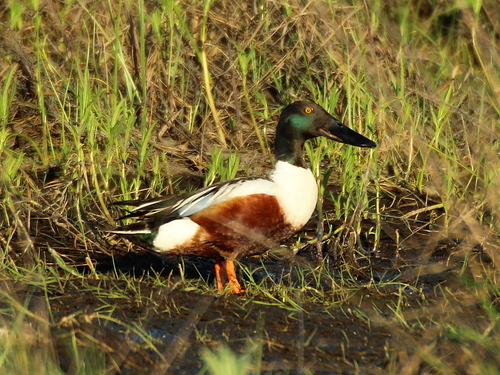 Northern Shoveler
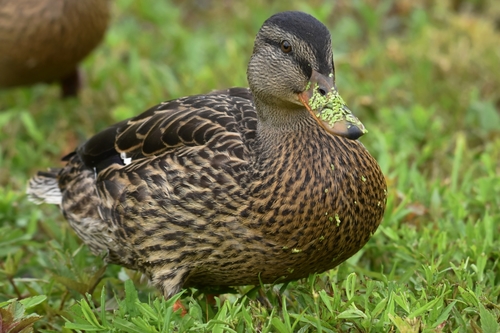 Mallard
In short
The most reliable way to separate Northern Shoveler from Mallard in the field is by structure: the shoveler’s bill is extremely large, broad, and spatulate, unlike the more typical duck bill of the Mallard. In flight, female and eclipse-plumaged shovelers show a plain grey forewing, while Mallards of all ages have a blue speculum bordered with white. Adult males in breeding plumage are easily told apart by the shoveler’s white chest and chestnut flanks, versus the Mallard’s grey body and chestnut breast. Females of both species are mottled brown, but the shoveler’s bill shape and color are distinctive. Size and jizz can help, but structure and wing pattern are the best field marks.
Identification tips
- Bill shape (all ages/sexes): Northern Shoveler has a huge, broad, spatulate bill; Mallard’s bill is shorter, narrower, and more typical of a dabbling duck. This is the single most reliable mark at any distance.
- Bill color (females): Female shoveler’s bill is grey with orange along the cutting edge and lower mandible; female Mallard’s bill is orange with dark markings or mottling.
- Wing pattern in flight (females, juveniles, eclipse males): Shoveler shows a plain grey (female) or pale blue (male) forewing with a green speculum separated by a white border; Mallard always shows a blue speculum bordered with white, often visible even at rest.
- Adult male plumage (breeding): Shoveler drake has a dark green head (less glossy than Mallard), white chest, chestnut flanks, and black bill; Mallard drake has a brighter green head, white neck ring, chestnut breast, grey body, and yellow bill.
- Adult female plumage: Both are mottled brown, but shoveler’s bill is much larger and more spatulate; Mallard’s bill is more typical in shape and color.
- Leg color: Both have orange to orange-red legs, not reliably diagnostic.
- Feeding behavior: Shovelers often feed by sweeping their bills side-to-side at the surface, filtering food; Mallards dabble more typically and rarely show this behavior.
- Body size and shape: Mallard is larger and bulkier; shoveler is smaller and more streamlined, but there is overlap.
- Head color (males): Both have green heads in breeding plumage, but the shoveler’s is less iridescent and can appear blackish at a distance or in poor light.
- Eclipse plumage: Male shoveler resembles female but keeps the pale blue/grey forewing; male Mallard in eclipse looks like female Mallard but retains the blue speculum and white borders.
- Flock size: Mallards are more likely to be seen in large flocks, especially outside breeding season; shovelers tend to form smaller groups.
- Habitat: Both use similar wetlands, but shovelers prefer invertebrate-rich marshes, while Mallards are more generalist and common in urban areas.
- Juvenile confusion: Juvenile Mallards quickly develop the blue speculum; juvenile shovelers have the distinctive bill shape early on, aiding separation.
- At rest: Bill shape and size are visible even when birds are not feeding or flying; use this for perched or loafing birds.
- Pitfalls: In eclipse or juvenile plumage, both species can look similar in body pattern; always check bill shape and wing pattern for confirmation.
Size
Mallard is the larger and heavier duck: typically 50–65 cm in length with an 81–98 cm wingspan, and weighing 0.7–1.6 kg. Northern Shoveler is smaller and lighter, at 44–52 cm long, with a 70–84 cm wingspan, and weighing 500–800 g (rarely up to 1 kg). In the field, Mallards often look bulkier and longer-bodied, while shovelers appear more streamlined and slightly smaller overall. However, there is some overlap in size, so this is only a supporting mark.
Plumage
- Juvenile/immature/female in flight: Female and eclipse-plumaged Northern Shovelers show a plain grey forewing, lacking the blue speculum and white borders of Mallard. Mallards (all ages/sexes) have a blue speculum bordered with white, which is visible in flight and often at rest.
- Adult male (breeding): Shoveler drake has a dark green (less iridescent than Mallard) head, white breast, chestnut belly/flanks, and a huge black bill. Mallard drake has a glossy green head, white neck ring, chestnut breast, grey body, and yellow bill.
- Adult female: Both are mottled brown, but the shoveler’s bill is much longer, broader, and spatulate, with grey and orange tones; Mallard’s bill is orange with dark markings and more typical in shape. Female shoveler’s forewing is grey; female Mallard’s is brownish with blue speculum.
- Eclipse plumage: Male shoveler resembles female but keeps the pale blue/grey forewing; male Mallard in eclipse resembles female Mallard but usually shows some retained blue speculum and white borders.
Behaviour
Northern Shovelers often feed by swinging their bills side-to-side at the water’s surface, filtering small invertebrates with their specialized lamellae. This feeding style is distinctive and less often seen in Mallards, which dabble more typically for plant material and small animals. Shovelers are less gregarious outside the breeding season, forming smaller flocks, while Mallards are highly social and often gather in large groups. Both species are dabbling ducks and can be seen together, but the shoveler’s unique feeding behavior and head-down, bill-swinging motion is a strong behavioral clue.
Habitat
Both species are widespread and use a variety of wetlands, but Northern Shoveler prefers mud-bottomed marshes rich in invertebrates, taking advantage of its specialized bill. Mallards are more generalist, found in almost any wetland, pond, or slow-moving river, and are more likely in urban and suburban parks. Both breed widely across the Northern Hemisphere and winter further south, with Mallard being even more cosmopolitan and adaptable to human-altered habitats.