

Pacific Emerald Dove vs Stephan's Dove
Chalcophaps longirostris versus Chalcophaps stephani
Play a quiz with Pacific Emerald Dove and Stephan's Dove
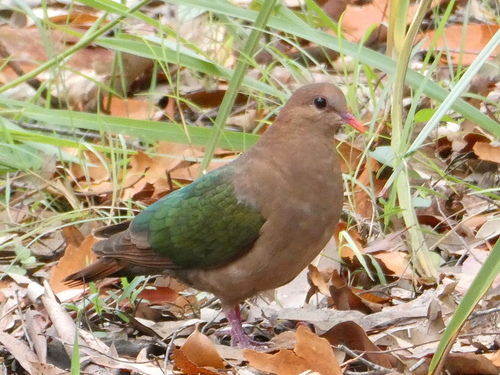 Pacific Emerald Dove
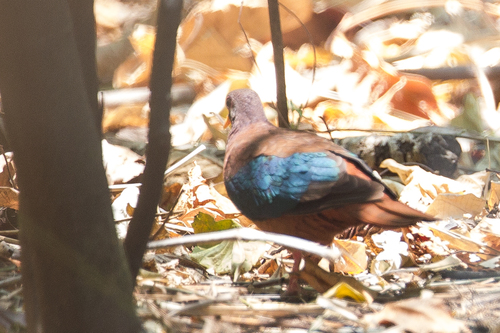 Stephan's Dove
In short
The most reliable field mark between Pacific Emerald Dove and Stephan's Dove is the color of the cap in adult males: Pacific Emerald Dove males show a clear grey crown, while Stephan's Dove males have a brownish crown. Both species are stocky, ground-dwelling pigeons with bright green wings, but Pacific Emerald Dove is more likely to show a vinous-pink head and underparts, and a white shoulder patch in males. Juvenile and female birds are trickier, as both are browner and lack the adult male's crisp head pattern, but Pacific Emerald Dove immatures show brown scalloping on the body and wings. In flight, Pacific Emerald Dove exposes a buff underwing and chestnut flight feathers, with blackish tail and flight feathers, and bold black-and-white barring on the lower back. Stephan's Dove is best separated by its overall browner upperparts and lack of the Pacific's white shoulder patch and grey crown, especially on perched males.
Identification tips
- Adult male crown color: Pacific Emerald Dove males have a clear grey crown; Stephan's Dove males have a brownish crown. This is the most reliable mark for adult males.
- White shoulder patch: Adult male Pacific Emerald Dove shows a distinct white patch at the edge of the shoulder, absent in Stephan's Dove. Females and immatures lack this mark.
- Vinous-pink underparts: Pacific Emerald Dove (especially males) has a dark vinous-pink head and underparts, fading to grey on the lower belly. Stephan's Dove is generally duller and browner below.
- Brown scalloping on immatures: Juvenile and immature Pacific Emerald Doves show brown scalloping on body and wing coverts, a mark not described for Stephan's Dove.
- Upperwing and flight pattern: In flight, Pacific Emerald Dove exposes buff underwings, chestnut flight feathers, blackish tail and flight feathers, and bold black-and-white barring on the lower back. Stephan's Dove is not described as showing these features, so their presence points to Pacific Emerald Dove.
- Overall upperpart color: Stephan's Dove is more uniformly brown-backed, while Pacific Emerald Dove has brighter emerald green wings and a browner cap in females/immatures.
- Bill and leg color: Pacific Emerald Dove has a bright red bill and rufous legs and feet; Stephan's Dove's bare part colors are not detailed, so this may help if seen well.
- Sex differences: Female Pacific Emerald Doves are browner, lack the white shoulder patch, and may show a grey mark on the shoulder. Stephan's Dove females are brown-backed and lack any grey or white on the crown or shoulder.
- Jizz and behavior: Both are stocky, ground-foraging, and often tame. Pacific Emerald Dove may walk away when disturbed rather than fly, but this is not unique.
- Range: In Australia, only Pacific Emerald Dove occurs. In New Guinea and nearby islands, both may be present.
- Habitat: Both prefer dense forest and woodland; habitat is not a separator in overlap zones.
- Vocalizations: Only Pacific Emerald Dove's voice is described; hearing the soft moaning coo or nasal 'hoo-hoo-hoon' supports that species.
- Group size: Both are usually solitary, in pairs, or small groups; not a separator.
- Courtship display: Both perform bowing/bobbing displays, not diagnostic.
- When in doubt: Focus on adult male head and shoulder pattern, and on brown scalloping in immatures. In flight, look for buff underwing and black-and-white lower back barring for Pacific Emerald Dove.
Size
Both species are medium-sized, stocky pigeons. Pacific Emerald Dove is typically 23–28 cm in length. No direct measurement is provided for Stephan's Dove, but it is described as closely related and morphologically similar, so expect very similar size and proportions. Size is not a reliable separator in the field.
Plumage
- Juvenile/Immature: Pacific Emerald Dove immatures resemble females but have distinctive brown scalloping on the body and wing coverts. Stephan's Dove immatures are not described in detail, but no mention of scalloping suggests this mark is useful for Pacific Emerald Dove.
- Adult Male: Pacific Emerald Dove males have a grey crown and a white patch on the shoulder, with bright emerald green wings and a vinous-pink head and underparts. Stephan's Dove males lack the grey crown and white shoulder patch, instead showing a brownish crown and overall browner upperparts, with green wings but a more subdued head and underpart coloration.
- Adult Female: Both species' females are browner overall and lack the white shoulder patch. Pacific Emerald Dove females may show a grey mark on the shoulder, but not a full patch. Stephan's Dove females are overall brown-backed and lack any grey or white on the crown or shoulder.
- In Flight: Pacific Emerald Dove shows buff underwings, chestnut flight feathers, blackish tail and flight feathers, and bold black-and-white bars on the lower back. Stephan's Dove's flight pattern is not described in detail, but the lack of mention of these features suggests they are less prominent or absent.
Behaviour
Both species are terrestrial, often foraging for fallen fruit on the ground and spending little time in trees except for roosting. Pacific Emerald Dove is noted for being quite tame and approachable, often walking away rather than flying when disturbed. Both species perform bobbing or bowing displays during courtship, with males lowering and raising their heads and tails in rhythmic motions. No major behavioral differences are highlighted that would reliably separate the two in the field.
Habitat
Pacific Emerald Dove is widespread in tropical and subtropical rainforests, dense wet woodlands, farms, gardens, mangroves, and coastal heaths across Indonesia, northern and eastern Australia, Timor-Leste, and Papua New Guinea. Stephan's Dove is found in Indonesia and Melanesia, from Sulawesi and Taliabu east through lowland New Guinea and its satellite islands to the Bismarck Archipelago and Solomon Islands. Both prefer dense forest or woodland, but Pacific Emerald Dove is the only one reaching Australia. In overlapping areas (New Guinea, some Indonesian islands), habitat is not a reliable separator.
Voice
Pacific Emerald Dove gives a low, soft moaning coo of about six to seven notes, starting quietly and rising, as well as a nasal 'hoo-hoo-hoon.' No specific vocal description is provided for Stephan's Dove, so voice is not a reliable separator unless Pacific Emerald Dove's calls are heard.