

White-quilled Bustard vs Black-bellied Bustard
Afrotis afraoides versus Lissotis melanogaster
Play a quiz with White-quilled Bustard and Black-bellied Bustard
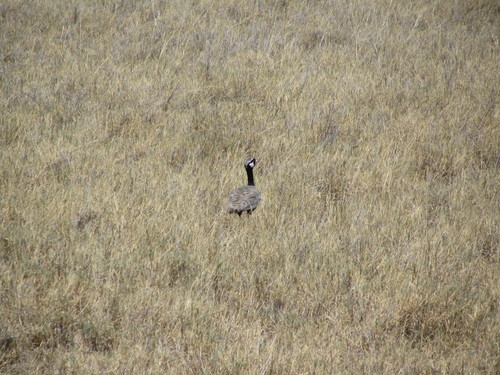 White-quilled Bustard
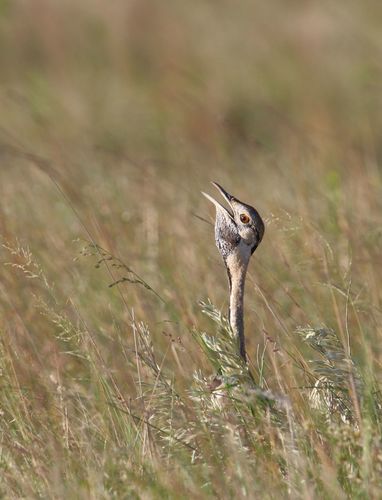 Black-bellied Bustard
In short
The most reliable field mark between these two bustards is the color of the primary feathers in flight: White-quilled Bustard (Afrotis afraoides) shows strikingly white primaries, while Black-bellied Bustard (Lissotis melanogaster) has white upperwings but with black-tipped flight feathers and a brown triangle at the wing base. Both species have black underparts in males, but leg and bill color, as well as head and neck pattern, help separate them. Females are trickier, but leg color and wing pattern remain useful. Watch for habitat context and leg color if the wing pattern is obscured.
Identification tips
- Primary feather color in flight (all ages): White-quilled Bustard shows mostly white primaries, creating a clean white wing flash. Black-bellied Bustard has white upperwings but with a brown triangle at the base and black tips to the flight feathers—look for these darker marks to rule out White-quilled.
- Leg color (adults, perched): White-quilled Bustard has bright yellow legs, while Black-bellied Bustard's legs are dull yellow. This is often visible when birds are walking or standing.
- Bill color (adults): White-quilled Bustard has a red bill, contrasting with the dull yellow bill of Black-bellied Bustard. Bill color can be subtle at distance but is diagnostic at close range.
- Male head and neck pattern: White-quilled Bustard males have a solid black head and neck, while Black-bellied Bustard males have a buffy brown neck with a thin black line down the front, a white chin and lores, and a boldly patterned head (black, white, buff). The contrast is especially clear in good light.
- Female upperparts: Female White-quilled Bustard is barred or chequered black and buff on the head, neck, breast, and upperparts, with a black belly. Female Black-bellied Bustard is plainer buff with dark brown mottling and fine wavy vermiculations on neck and breast, lacking the bold barring of White-quilled.
- Juvenile marks: Juvenile Black-bellied Bustard is duller and darker, with a dark grey crown and buff spots on the wing. Juvenile White-quilled Bustard is not described in detail, but the white primary panel should still be present in flight.
- Upperwing in flight (adults and immatures): White-quilled Bustard's upperwing is mostly white, while Black-bellied Bustard's has a brown triangle at the base and black tips. This is a key mark when birds flush.
- Underparts (males): Both have black underparts, but White-quilled Bustard's black extends to the head and neck, while Black-bellied Bustard's black is restricted to the belly and breast, with a buffy brown neck.
- Tail pattern: Black-bellied Bustard has a brown and buff tail with four or five narrow dark brown bands, which may be visible when the tail is fanned. White-quilled Bustard's tail pattern is not described as distinctive.
- Structure and jizz: Black-bellied Bustard appears longer-necked and lankier, especially when alert. White-quilled Bustard is more compact and upright, especially when standing.
- Habitat context: If seen in tall grass or after heavy rain, Black-bellied Bustard is more likely. In open, drier grassland and scrub, White-quilled Bustard is more likely.
- Sex differences: Both species show sexual dimorphism, but the head and neck pattern in males is a strong separator. Females are trickier, but barring (White-quilled) vs. mottling/vermiculations (Black-bellied) helps.
- When marks fail: At long range or in poor light, rely on wing pattern in flight and leg color when perched. If both are obscured, habitat and jizz may offer clues, but beware overlap in range.
- Pitfalls: Both species can show white on the wing, but only White-quilled Bustard has clean white primaries without dark tips or triangles. Do not rely solely on underpart color in males, as both can appear black-bellied.
- Not diagnostic: Voice is not described as a separator in the sources; do not use vocalizations for field separation based on current information.
Size
Black-bellied Bustard is the larger of the two, measuring 58–65 cm in length, while the size of White-quilled Bustard is not specified in the sources but is generally smaller and more compact in jizz. Both are medium-sized bustards, but Black-bellied appears longer-necked and lankier, especially when alert. Bill and leg proportions are similar, but the color differs: White-quilled Bustard has bright yellow legs and a red bill, while Black-bellied Bustard has dull yellow legs and bill.
Plumage
- In flight (all ages): White-quilled Bustard shows mostly white primaries, giving a bold white flash on the wing. Black-bellied Bustard's upperwing is also white but with a brown triangle at the base and black tips to the flight feathers, so the white is less clean and more patterned.
- Adult males: Both have black underparts, but White-quilled Bustard males are black on head, neck, and underparts, with black-and-white barring on back and wings. Black-bellied Bustard males have a buffy brown neck with a thin black line, a boldly marked head (black, white, buff), and a white chin and lores; their upperparts are tawny buff with black and brown marks.
- Adult females: White-quilled Bustard females are barred or chequered black and buff on head, neck, breast, and upperparts, with a black belly. Black-bellied Bustard females are plainer buff with dark brown mottling and fine wavy vermiculations on neck and breast; their underparts are not as distinctly black.
- Juveniles: Black-bellied Bustard juveniles are duller and darker, with a dark grey crown and buff spots on the wing. White-quilled Bustard juvenile plumage is not described, but the white primary panel should still be visible in flight.
Behaviour
Both species are ground-dwelling and favor open country, often walking with a deliberate gait. Black-bellied Bustard tends to be more secretive and is often seen only after heavy rains, sometimes in taller grass or cultivated fields. White-quilled Bustard is more likely to be seen in open grassland and scrub, often standing more upright and showing its bright leg color. Both flush reluctantly, but the White-quilled Bustard may appear more compact and less elongated in flight.
Habitat
White-quilled Bustard is widespread in open grassland and scrub across Southern Africa. Black-bellied Bustard prefers savanna, tall open grassland, and cultivated fields, often in areas with higher rainfall and sometimes only present after heavy rain. Their ranges overlap in parts of Southern Africa, Zimbabwe, and Botswana, but Black-bellied Bustard is more tied to wetter habitats and can be absent from drier grasslands where White-quilled Bustard is common.
White-quilled Bustard · Black-bellied Bustard · My Tricky Birds