

Asian House Martin vs Nepal House Martin
Delichon dasypus versus Delichon nipalense
Play a quiz with Asian House Martin and Nepal House Martin
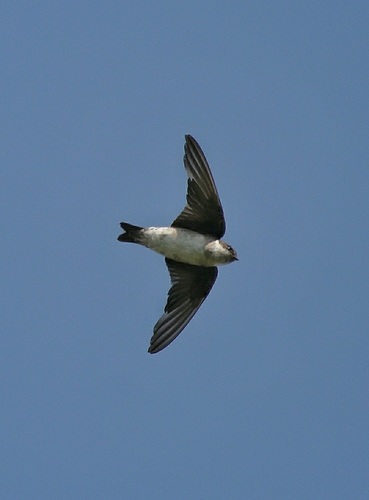 Asian House Martin
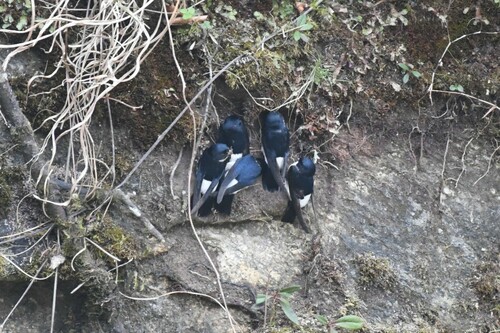 Nepal House Martin
In short
The most reliable field mark to separate Asian House Martin from Nepal House Martin is the presence of a black chin and black undertail coverts in Nepal House Martin of all ages, versus the entirely pale throat and undertail in Asian House Martin. Tail shape is also key: Nepal House Martin has a much squarer tail, while Asian House Martin’s is slightly forked. Juveniles of both species are duller, but the black chin on Nepal House Martin remains a strong clue. In flight or perched, always check the throat and undertail, then tail shape. Both species share blue-black upperparts and a white rump, so focus on these contrasts, especially in mixed colonies or mountain habitats.
Identification tips
- Check the throat and undertail coverts first: Nepal House Martin always shows a black chin (extent varies by subspecies and region) and black undertail coverts, even in juveniles. Asian House Martin has a pale throat and undertail at all ages.
- Tail shape is key: Nepal House Martin has a much squarer tail, while Asian House Martin’s tail is slightly forked. This is visible both perched and in flight.
- Juvenile confusion: Both species are duller and less glossy as juveniles, but the black chin and undertail of Nepal House Martin remain clear. Asian House Martin juveniles lack any black on the throat or undertail.
- Upperparts and rump: Both species have blue-black upperparts and a white rump. Asian House Martin may be slightly darker above, and some subspecies have a brighter blue gloss, but this is subtle and unreliable.
- Underparts: Asian House Martin has pale grey underparts, sometimes with a grey wash, while Nepal House Martin’s underparts are white, but this is not a strong separator due to variation and lighting.
- Sex differences: Both species are sexually monomorphic, but male Asian House Martin can be a bit whiter below in fresh plumage. This is not a strong field mark.
- Subspecies variation: In Nepal House Martin, the eastern race (cuttingi) has more extensive black on the throat and breast; western birds may have black limited to the chin. Always look for at least some black at the chin.
- Flight jizz: Nepal House Martin’s squarer tail can make its flight look less forked and slightly bulkier. Asian House Martin’s forked tail is subtle but present.
- Vocalizations: Calls are not reliably separable in the field; both are generally quiet and give short, unremarkable calls.
- Habitat overlap: Both species breed in similar mountain habitats and may nest on cliffs or buildings. Do not rely on habitat alone for separation.
- Colony context: In mixed colonies, use throat and undertail color, and tail shape, to separate individuals. Do not rely on upperpart gloss or rump brightness.
- Bill, legs, and feet: Both have brownish-pink legs and feet covered with white feathers, and a black bill. These are not useful for separation.
- Size: Nepal House Martin is slightly larger (13 cm vs 12 cm), but this is not noticeable in the field.
- Lighting pitfalls: Glossy blue-black upperparts and white rumps can look similar in bright light; always prioritize throat, undertail, and tail shape.
- Seasonal confusion: Asian House Martin is migratory and may be present outside the breeding season, but both can occur together in the Himalayas. Always use plumage and structure for ID.
Size
Asian House Martin averages about 12 cm in length and 18 g in mass [wikidata], while Nepal House Martin is slightly larger at 13 cm, though mass is not specified. The difference is subtle and not reliable in the field. Both are compact, broad-winged swallows, but Nepal House Martin can appear a bit bulkier, especially in the eastern race (D. n. cuttingi) with slightly longer wings.
Plumage
- Juveniles/immatures: Both species are less glossy than adults. Nepal House Martin juveniles have a duskier throat and buff-washed underparts, but crucially retain a dark (blackish) chin and black undertail coverts. Asian House Martin juveniles are dark brown above, sometimes with a brownish rump, and have grey-white underparts with no black on the chin or undertail.
- Adults: Asian House Martin is dark steel blue above with a white rump, pale grey underparts, and a slightly forked tail. Nepal House Martin is blue-black above with a pure white rump, white underparts, but always a black chin (extent varies by subspecies) and black undertail coverts, plus a much squarer tail. Both sexes are similar in both species, though male Asian House Martin can be whiter below in fresh plumage.
- Subspecies: Nepal House Martin's eastern race (D. n. cuttingi) has the most extensive black on the throat and breast, while western birds may have black limited to the chin. Asian House Martin subspecies vary mainly in upperpart gloss and rump brightness, not in throat or undertail color.
Behaviour
Both species are aerial insectivores, often feeding high above ground. Nepal House Martin is described as exceptionally fast-flying, but this is not a reliable field separation. Both nest colonially under overhangs, typically on cliffs, but Asian House Martin may more readily use buildings. Both species build mud nests and may be seen collecting mud near water. Their flight style is similar: agile, with rapid wingbeats and gliding, but Nepal House Martin’s squarer tail may make its flight look slightly less forked.
Habitat
Both species breed in the Himalayas and adjacent mountains, often in river valleys or on rugged ridges. Asian House Martin is migratory, breeding in central/eastern Asia and wintering further south, while Nepal House Martin is non-migratory and resident in the Himalayas from NW India through Nepal to northern Vietnam and adjacent China. Nepal House Martin is more strictly tied to high-altitude cliffs (1,000–4,000 m), while Asian House Martin can be found at a wider range of elevations, including lower mountains and sometimes buildings. Overlap is possible in the Himalayas, so habitat alone is not diagnostic.
Voice
Both species are generally quiet. Asian House Martin gives a rippling metallic trill or sibilant twitter, and a dry metallic cheep, often with two or three syllables—similar to Common House Martin but more rasping. Nepal House Martin gives an occasional short 'chi-i' call in flight and a brief three-note breeding song, but is otherwise quiet. Vocal differences are subtle and not reliable for separation in the field.